Sightlines · a mini film course
Watchers and the Watched: Crime, Darkness, and the Art of Looking
There's a feeling these films share that's almost impossible to name without seeing it: the sense that the camera itself is suspicious. Not of characters, exactly — but of its own ability to show you the truth. Each of these films is built around a detective, an investigator, or someone pressed against the edge of a criminal world, and every one of them uses the machinery of crime cinema to ask something the genre usually refuses to ask: what does it actually mean to see something, and does seeing ever become knowing? Together they form a kind of shadow curriculum in how darkness — moral, photographic, institutional — gets made on screen.
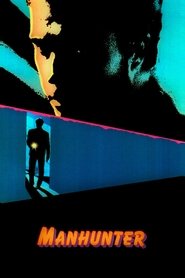
Manhunter (1986)
Michael Mann's film is the place to start, because it makes the question explicit. Will Graham's method isn't collecting evidence — it's becoming the person he's hunting, speaking their reasoning aloud in the present tense, occupying their gaze. Watch how Mann and cinematographer Dante Spinotti frame him: forever watching something, with the camera watching him watching. The palette runs cold — clinical blues, hard whites, surgical greens — and the architecture is all glass and symmetry, spaces that feel designed to be seen through rather than lived in. Notice too how Tangerine Dream's synthesizer score doesn't underscore the action so much as replace interiority: we don't get inside Graham's head through dialogue but through the way the music and the images press together. Before The Silence of the Lambs defined the serial-killer film for a generation, this film invented its grammar.
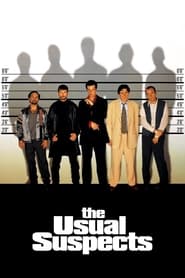
The Usual Suspects (1995)
Where Manhunter is about what it costs to see truly, this film is about what happens when someone builds a story knowing exactly how you'll believe it. Verbal Kint sits in a stripped, fluorescent interrogation room and narrates in flashback — and Newton Thomas Sigel photographs those flashbacks with full cinematic conviction: deepening shadows, careful compositions, every visual marker of reliable memory. The trick is that the flashback image almost always carries the authority of fact. Watch how Singer exploits that habit. The interrogation room is deliberately drab and institutional; the baroque, shadowy sequences Verbal summons feel more real than the room he's sitting in. The film is an education in how much of what we trust on screen we trust purely by convention.
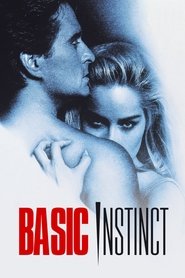
Basic Instinct (1992)
Paul Verhoeven and cinematographer Jan de Bont build their film on a cold, affluent palette — pale blues, bleached Pacific light, the Nordic glare of Sharon Stone's cliffside house — and then set the camera moving in long, uninterrupted glides that never quite land on certainty. Watch the interrogation scene especially: five men ranged around one woman in white, the lens circling her like a suspicion that can't find purchase. De Bont's camera moves are smooth and seductive rather than urgent, which means you're always slightly off-balance between watching a thriller and watching something more like a demonstration. Catherine Tramell may be constructing events the way a novelist constructs a plot, and Verhoeven has the audacity to let her cinematically outmaneuver the film that contains her.
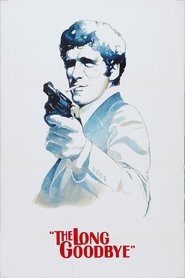
The Long Goodbye (1973)
Robert Altman and cinematographer Vilmos Zsigmond arrived at one of American cinema's great anti-classical decisions: a camera that wanders, zooms softly, catches the margins of a scene as readily as its centre, and pointedly refuses to make Philip Marlowe's perception feel authoritative. Watch how often Gould's Marlowe is slightly off to one side of what matters, still moving with complete conviction, while the world quietly rearranges itself beyond his awareness. This is a Los Angeles film as much as a detective film — Zsigmond's sunlit, slightly overexposed California exterior work sits in deliberate tension with the noir murk we expect, and that tension is the argument. Elliott Gould's Marlowe is the last person in the city still running on a code the city discarded years ago, and the camera knows.

Sicario (2015)
Roger Deakins approaches the border landscape geologically — his wide desert frames dwarf human figures without romanticizing the emptiness, refusing the mythic register of the Western even while quoting its compositions. Watch where Emily Blunt's Kate is placed in almost every scene: in doorways while the shooting starts, in the back seat of a convoy that won't tell her its destination, at the edge of briefings where the real decisions are being made just out of earshot. Denis Villeneuve keeps converting what should be action sequences into things you can only witness. The famous twelve-minute traffic sequence is all procedure and dread, with the camera registering everything Kate registers and drawing none of the conclusions a thriller camera is supposed to draw. Jóhann Jóhannsson's score doesn't resolve tension — it colonizes it.
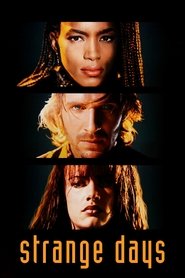
Strange Days (1995)
Kathryn Bigelow's film physically splits itself in two. Matthew Leonetti's regular camera gives you a grimy neon-soaked Los Angeles — wet streets, sodium orange, the queasy glow of millennium's edge. Then a second visual register kicks in: custom-built POV rigs that shoot through a character's literal eyes, immersive and unstabilized, the world lurching exactly as a body under adrenaline lurches. The SQUID technology the film imagines — a wire rig that records the full sensorium and plays it back inside your skull — is Bigelow's subject and her method simultaneously. Notice that she made these sequences years before GoPro, years before bodycam footage, years before VR made first-person vision a commercial product. The opening robbery is not a sequence you watch; it's something closer to something that happens to you. When the image cuts out, the reason it cuts out matters.
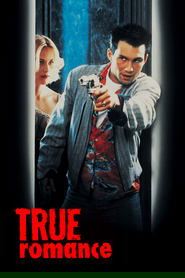
True Romance (1993)
Tony Scott and cinematographer Jeffrey Kimball treat image as sensation first — a palette of bruised blues and molten ambers saturated almost to abstraction, lit with the frank artificiality of a perfume advertisement. This is a film that knows it was made by someone raised on movies, about someone raised on movies, for an audience raised on movies, and it wears that without embarrassment. Watch the scene where Val Kilmer's Elvis appears in a bathroom mirror to give Clarence advice: no wavery dream-signal, no soft dissolve, just the King leaning in, lit the same way everything else is lit, completely matter-of-fact. The film's wager is that a self built entirely from borrowed images and secondhand heroes can still be a real self. Quentin Tarantino's script feeds the violence through a genuinely romantic sensibility, and the tension between those two registers — extreme tenderness, extreme brutality in the same frame — is the whole experiment.
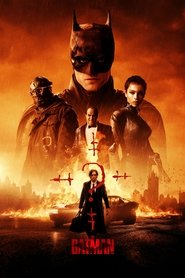
The Batman (2022)
Greig Fraser built the film on a palette of near-monochrome darkness punctuated by sodium amber and deep blood reds — famously underlit even by blockbuster standards, faces falling into shadow, practical sources motivating every pool of light. The visual language draws directly on Gordon Willis's work for The Godfather: radically underexposed frames, faces with eyes lost in darkness, light that feels like something the city earns rather than something the camera provides. Watch what Matt Reeves does with surveillance — the film opens with Batman watching before he moves, and the watching turns out to be the plot. The Riddler sends ciphers to the Batman, not to the police, which means the film involves you as a co-decoder. Notice how the cipher scenes feel different from standard procedural clue-gathering: you're not watching someone find evidence, you're watching someone be addressed.
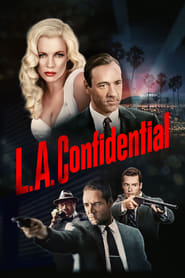
L.A. Confidential (1997)
Dante Spinotti — who also shot Manhunter — develops here a warm, amber-golden palette that reproduces the glamour of 1950s Hollywood cinematography with complete fidelity. The venetian-blind shadows fall exactly right, the lamplight on Lynn Bracken's face is lit with the reverence of a genuine studio portrait. The film knows this: its central criminal enterprise involves women surgically altered to resemble movie stars and sold as the real thing, and Curtis Hanson lights them with the full glamour grammar anyway. The forgery is beautiful. The beauty is a forgery. Watch how Spinotti refuses to choose between those two facts by allowing his camera to treat both with equal tenderness. This is a film about three men with three different relationships to what the law says it is versus what it does — and each one is photographed like a different kind of classic Hollywood archetype.
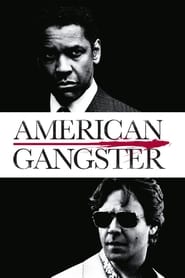
American Gangster (2007)
Steven Savides constructs the film on a fundamental chromatic argument: Frank Lucas's world is amber warmth and ordered domestic luxury; Richie Roberts's world is institutional grey and street-level ambient cold. Watch these as two visual vocabularies in the same film rather than just two narrative strands. When the palettes bleed together, something has shifted. Notice particularly how Ridley Scott treats clothing — the famous chinchilla coat, but also the grey suit, the Thanksgiving table, the way Frank Lucas organises his world through controlled surfaces. Bodies in this film carry their social position visibly, and the camera is forensic about it. Scott's outsider relationship to American mythology gives the film the quality of analysis: he finds the language of brand management and capitalism already living inside the drug trade, and he photographs that correspondence with the neutrality of a documentary.

Memories of Murder (2003)
Kim Hyung-goo's wide, often static anamorphic frames give the Korean countryside the same visual weight as the human figures within it — the landscape absorbs the murders rather than isolating them, which is the film's first and most important argument. Watch how Bong Joon-ho uses comedy as a structural element alongside violence and dread, not to relieve tension but to register institutional absurdity. The police procedural promises that perception leads to action leads to resolution — this film systematically dismantles that promise, and it does so not through nihilism but through an almost anthropological patience. The evidence keeps failing to mean what it should mean. The physical comedy of the early investigations is inseparable from the tragedy; they're the same thing, filmed with the same unhurried lateral drift.
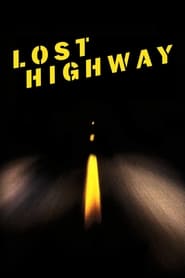
Lost Highway (1997)
Peter Deming photographs the Madison house as near-abstract shadow — rooms defined by what can't be seen, figures walking into blackness and disappearing. Lynch and Deming oppose this engulfing darkness against the bleached, sun-struck California desert exteriors: two visual worlds so opposed they feel like different films threaded together. They are. Watch the transitions between the film's two sections for what they withhold rather than what they explain — the film does not tell you what the shift means, and that silence is deliberate and load-bearing. Notice also how video appears as a material within the film: the mysterious cassette tapes that record spaces that were empty when the characters were in them. Lynch is interested in the recording image as something that sees differently from human eyes, that catches what the conscious self refuses. Pay attention to the Mystery Man — specifically to his face, and to where he appears.
Why Watch These Together
What this group of films rewards, watched as a sequence, is an education in what looking costs. Each film gives you a person — detective, investigator, profiler, dealer in stolen experience — whose whole project is to see truly, and each film systematically reveals the ways that project fails, or succeeds only at terrible price, or turns out to have been somebody else's project all along. The techniques are as varied as the decades: Altman's wandering camera that refuses authority, Lynch's swallowing darkness that refuses chronology, Bigelow's body-mounted rigs that refuse distance, Fraser's underlit Gotham that refuses spectacle. But the underlying question is the same across all of them. The crime film has always promised that investigation leads somewhere — that the machinery of looking eventually produces truth. These films love that promise too much to let it off easily, and watching them together, you begin to see the machinery itself.