Sightlines · a mini film course
When Looking Becomes the Story: Eleven Films That Trust You to Watch
Most movies run on a simple engine: a character sees a problem, does something about it, and the editing hurries us to the next thing. The films on this list unplug that engine — on purpose. In each of them, the camera watches rather than chases. Shots are held long past the point where an ordinary film would cut. People find themselves in situations too large, too strange, or too broken to act on, and so they — and we — are left simply to look, listen, and endure. That sounds austere. It isn't. It's where these films hide their astonishments: a camera that dives underwater without a cut, a street that changes years while you watch it, a dead woman who surfaces out of lamplight like a photograph developing. Here is what to look for.

I Am Cuba (1964)
Watch the rooftop party near the beginning: the camera glides across a poolside crowd, descends with the bathers, and then — without a cut — slides beneath the surface of the swimming pool and keeps filming, looking up through the water. No one could be holding it; cinematographer Sergei Urusevsky built custom pulleys, platforms, and waterproof housings to engineer that weightlessness by hand, a full decade before the Steadicam existed. The seeing in this film belongs to no single person — it drifts like a current through crowds, rooftops, and cane fields, treating Cuba itself as the protagonist.
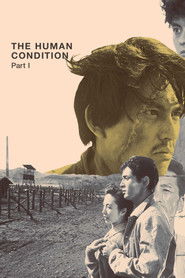
The Human Condition I: No Greater Love (1959)
Notice how the enormous widescreen frame does half the storytelling. Yoshio Miyajima organizes the image into grids of confinement — fence lines, watchtowers, rows of laborers — and stretches the Manchurian plain so wide that Kaji, a man determined to run a labor camp humanely, looks like a single comma in a long, indifferent sentence. Watch how social pressure is composed into the frame, foreground against background, rather than explained in dialogue. The shape of the image tells you what one man is up against before he does anything at all.
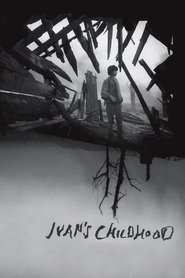
Ivan's Childhood (1962)
Tarkovsky's first feature is built across a fault line, and the seam is the subject: a boy's dreams — birch trees, water, light through leaves — cut hard against the war that has made him a scout crawling through German lines. Watch how those cuts land flat, with no dissolve and no consoling chord. Notice too the deep-focus night photography and the low angles that press Ivan's small figure against vast, threatening skies. The dreams explain nothing about the plot; they exist to show you what's been stolen.
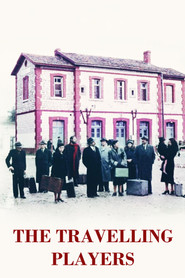
The Travelling Players (1975)
Angelopoulos built this four-hour history of Greece out of roughly eighty shots — and the great trick is that time travels inside them. Watch the famous street shot: the camera follows marchers, loses them at a corner, waits on the wet stone, and when people return, the banners belong to a different year. No cut, no announcement — the street itself did the time-travelling. A theory of how history repeats, smuggled inside a camera move.
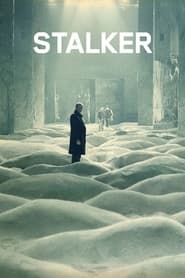
Stalker (1979)
Three men risk prison to enter a forbidden Zone — and then, mostly, they stop. They sit in wet grass, argue, lie down. Watch the extraordinary passage where the camera lies in shallow water and drifts over submerged objects — coins, a syringe, a scrap of religious painting — refusing to resolve into a clue or a symbol. Keep waiting for the film to explain; notice the moment you stop waiting and the looking itself becomes the film's substance.
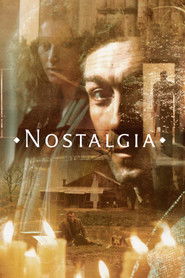
Nostalgia (1983)
Watch for the scene in a drained thermal pool: a man tries to carry a lit candle from one side to the other, the steam keeps snuffing it, and he starts over — nine minutes, one shot, real precariousness rather than a simulation of it. Nothing is "happening"; everything is at stake. Tarkovsky uses duration the way other directors use plot: the camera moves slowly, pressure builds through sheer time, and a small physical task becomes an act of faith.
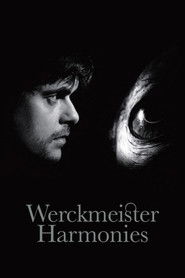
Werckmeister Harmonies (2001)
The opening is the whole film in miniature: at last call in a provincial bar, a postman arranges drunken men into a working model of a solar eclipse — you be the sun, you the earth — and sets them slowly orbiting, in one unbroken take of nearly ten minutes. Nothing is accomplished, and it's mesmerizing. Watch how Tarr builds meaning through choreographed movement and duration rather than plot, and watch Lars Rudolph's face — transparent, unguarded — a face on which events register rather than a mind that schemes.
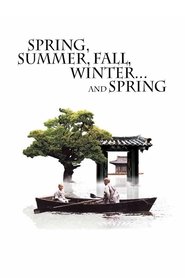
Spring, Summer, Fall, Winter... and Spring (2003)
Kim Ki-duk trained as a painter, and it shows: a floating temple centered on a lake, encircled by mountains, filmed in symmetrical, frontally composed tableaux whose palette shifts with the seasons. There is almost no dialogue — meaning is carried by water, wind, birds, the creak of a rowboat. Watch the early lesson with the stones: a weight, once tied, is carried in the body for a lifetime. Weight, not plot, is what this film is made of.
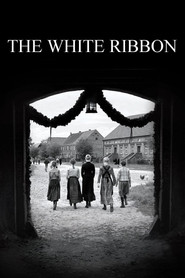
The White Ribbon (2009)
Watch what Haneke won't show you. A wire is strung across a path, a horse goes down, a man is injured — and we never see the hands that tied it. Across a village's accumulating cruelties, the editing keeps ending scenes before their violence: a punishment approaches and the door closes on it; we rejoin an interrogation in its flat aftermath. Christian Berger's camera barely moves, holding a middle distance that refuses comfort — and the not-seeing slowly becomes the subject.
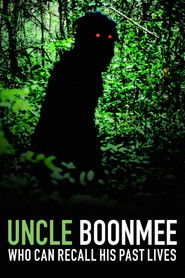
Uncle Boonmee Who Can Recall His Past Lives (2010)
Watch the dinner on the veranda, lit by oil-lamp and the last of dusk, when a chair that was empty is no longer empty — the dead arrive not with a music sting but by slow degrees, surfacing out of the dark like a print in a developing bath. The wonder lands precisely because nobody in the frame treats it as wonder: food is passed, mild curiosity is offered. Apichatpong holds the shot past where a normal film would cut, keeps real darkness in his interiors, and lets ghosts and monkey spirits sit at the table like family. Because here, they are.
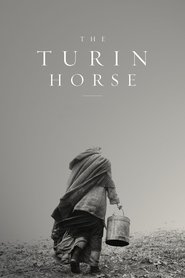
The Turin Horse (2011)
A father and daughter, a farmhouse, a dying horse, wind that never stops — filmed in some of the most sustained black-and-white cinematography of the century, across just 146 shots and six days. Watch them eat the boiled potato: nothing is explained, the camera holds, and you wait the way they wait. The long take here isn't a flourish; it's the whole argument. You don't receive information about a world running down — you inhabit it, and feel the time pass in your own body.
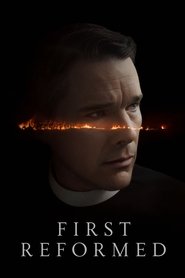
First Reformed (2018)
Schrader distills this whole tradition into an American key. The camera is almost entirely static, framing a pastor head-on with near-liturgical symmetry, so that when it finally does move, the movement lands like an event. Watch the long counseling scene: two figures in a fixed frame, no cutting back and forth for reactions, while an argument about despair unfolds in real time. A man who perceives everything — a dying planet, a failing body, a hollowed-out faith — and the film teaches you his posture before it shows you a single act: sit still, look, endure.
Why watch them together? Because they train you. The first time a shot refuses to end, you'll fidget; by the third or fourth film, you'll notice yourself leaning in instead — reading light, weight, distance, and duration the way you'd normally read dialogue. These eleven films, made across five decades and half the world, keep passing the same discoveries hand to hand: Tarkovsky learns from Dovzhenko and Bresson, Tarr learns from Tarkovsky and Jancsó, Schrader learns from all of them. Watched in sequence, they stop feeling like slow films and start feeling like one long conversation about what a camera can do when it stops rushing — and what you can see when you're given the time to really look.