Sightlines · a mini film course
When Seeing Outruns Doing: War Films About the Gap Between the Eye and the Hand
Every war film has soldiers who act — charge, fire, hold the line. The films in this set are stranger and richer than that. Again and again, they give us people who can see everything and do almost nothing: a boy whose only refuge from war is his dreams, a schoolboy whose glance may cost more than any deed, a veteran flying home over a country that no longer needs him. These are war films where the camera watches rather than chases, where waiting matters more than winning, where the most important moments happen after the action can no longer help anyone. Watching them together, you'll notice a shared instinct: the filmmakers slow down, hold the frame, and let you feel what their characters feel — the terrible weight of looking on.
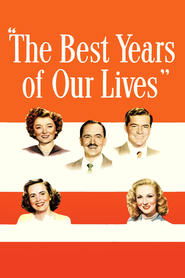
The Best Years of Our Lives (1946)
Start here, at the source. Gregg Toland's deep-focus photography keeps the whole room sharp at once — foreground and far background equally in focus — so that a drama can unfold across the full depth of a single shot without a cut. Watch the famous drugstore scene: one confrontation plays up close while something else entirely happens far across the store, and you're asked to hold both in view at the same time. Three men come home from war, and the film's great subject is what happens when trained decisiveness meets a world that only asks you to look at it.
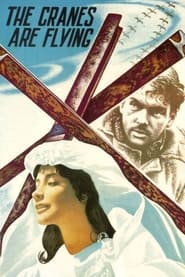
The Cranes Are Flying (1957)
Sergei Urusevsky's camera is the most athletic in this set — it spirals up staircases, wheels into treetops, moves as if it has a heartbeat of its own. The stunning trick to watch for: at moments of extremity, when a character falls still, the camera takes over the motion the body has given up, and the world itself seems to turn. This is the film that put post-Stalin Soviet cinema back on the world stage, relocating the war from the battlefield to the home front and one wounded heart.
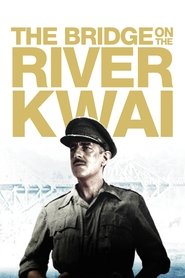
The Bridge on the River Kwai (1957)
Lean opens with prisoners whistling — not singing, whistling — as they march in perfect formation through a jungle that has no use for formations. That image is the whole film: order asserted against an indifferent world. Watch how Jack Hildyard's widescreen photography makes the jungle press down and enclose even in the widest frame, and how Alec Guinness plays a man whose professional pride is both entirely admirable and quietly catastrophic. The war-movie engine runs beautifully here — and Lean is up to something sly with it.
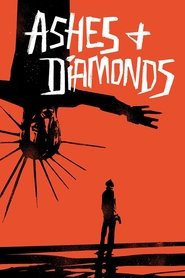
Ashes and Diamonds (1958)
A young man wears dark glasses indoors, at night, in a country where the war has just ended. Zbigniew Cybulski's sunglasses were his own, kept because they looked right — and they name the film's predicament: a soldier built to see-and-strike, in a world where the striking no longer fits. Jerzy Wójcik's black-and-white photography pools shadow over faces like classic film noir, and the whole story compresses into a single night in a hotel — a small world holding an entire country's crisis.
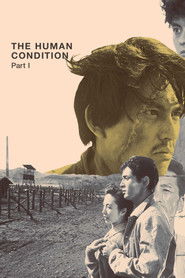
The Human Condition I: No Greater Love (1959)
Kobayashi opens his enormous humanist cycle with a man dwarfed by his own frame: Yoshio Miyajima stretches the widescreen image so far to either side that a single figure looks like a comma in a long, indifferent sentence. Watch how fence lines, watchtowers, and rows of laborers turn the wide frame into a grid of confinement — the space itself becomes the trap. The question the film asks in every composition: can one man's decency survive inside a system built to grind it down?
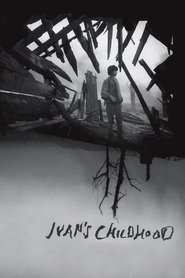
Ivan's Childhood (1962)
Tarkovsky's debut is built across a fault line: the wartime scenes — tense, low-angled, all mist and river reeds — and the dreams, luminous with birch trees and light falling through leaves like water. Watch the cuts between them: no dissolve, no consoling music, just the hardest possible seam. The dreams aren't flashbacks and they explain nothing; they're the childhood the war has stolen, kept alive in a parallel register. This is where Soviet Thaw cinema and one of the great film careers begin at once.
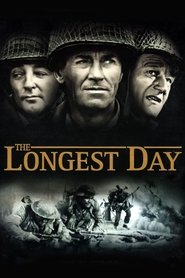
The Longest Day (1962)
The counterweight in this set: a film almost defiantly built out of men deciding and then acting, at colossal scale. Its Oscar-winning black-and-white CinemaScope photography favors deep, populated frames — masses of men and machines — in the idiom of combat photojournalism. But watch for one man hanging from a church steeple, parachute snagged, deafened by the bells, able only to look at the battle below him. He's the exception that reveals what everything around him is.
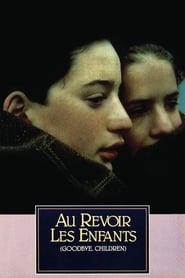
The Best Way to See the Hinge — Au Revoir les Enfants (1987)
Malle rebuilt a morning from his own boyhood, forty years on, and the whole film is engineered to deliver a single glance — a look that lasts less than a second and can do nothing. Watch how Renato Berta's cold, wintry naturalism refuses melodrama, and how young Gaspard Manesse plays his role almost entirely through watchfulness rather than deed. A war film from the civilian margins, where the largest events of history reach into a boarding school and a child can only look.
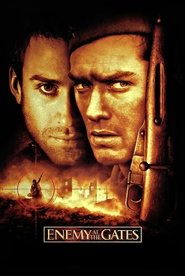
Enemy at the Gates (2001)
A war film built out of stillness: two snipers in the rubble of Stalingrad, each waiting for the other to move first. Robert Fraisse shoots the siege in steel blues and ash grays, punctured by the warm flare of fire — and the film keeps returning to the strange image of a man whose entire being has narrowed to one eye at a lens. Notice the double pressure on the hero: the enemy ahead, and his own state behind, manufacturing him into a legend whether he likes it or not.
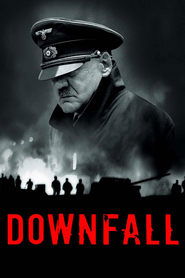
Downfall (2004)
Rainer Klausmann's handheld camera traps you in the bunker's narrow corridors and shallow focus, close to faces with nowhere to retreat. The film's chilling engine: a man moving armies across a map — armies that no longer exist — while generals report phantom divisions in the measured tones of real ones. Command has come completely unhooked from the world above. Watch how the single confined location becomes a study of a closed system refusing every piece of contradicting evidence.
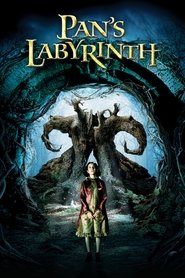
Pan's Labyrinth (2006)
A girl draws a door on a blank wall with chalk, pushes, and it opens — for her. The adults see only stone. Del Toro made two films at once — a war picture about hunting guerrillas in the Spanish hills of 1944, and a fairy tale of three tests — and refuses to tell you which is true. Watch Guillermo Navarro's color logic: cold steel blues for the captain's world, warm ambers for the fantasy spaces, the two palettes bleeding into each other at thresholds. Disobedience, here, is the highest virtue.
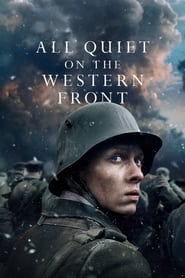
All Quiet on the Western Front (2022)
The opening minutes contain the whole film: a soldier dies in a charge, and the camera follows his uniform — stripped, laundered, stitched, folded, reissued to an eager new recruit. No music; cuts with the rhythm of an inventory. Before anyone speaks a word of disillusionment, Berger has shown you a machine that consumes bodies and recycles the packaging. The first German-language adaptation of Remarque's novel — a correction of a long, painful absence — and watch how it cross-cuts between comfortable rooms where decisions are made and the mud where they're paid for.
Why watch these together? Because arranged this way, eleven war films become one long conversation about what war does to the link between seeing and doing. The Longest Day shows the machinery running at full power; The Best Years of Our Lives shows it going slack the moment peace arrives; Ashes and Diamonds and Ivan's Childhood show young men built for action stranded in worlds that no longer answer to it; Downfall shows the machinery grinding on in a vacuum; and the children of Au Revoir les Enfants and Pan's Labyrinth never had the machinery at all — only their eyes, and what imagination could build behind them. Watch for the recurring choices: cameras that hold rather than cut, wide frames that dwarf their people, silence where you'd expect music. These filmmakers trust you to sit inside the looking. Give them your patience, and they'll give you the war film's secret subject: not the battle, but the human being left watching it.