Sightlines · a mini film course
When Seeing Is Not Enough: War, Witness, and the Limits of Action
There is a strange stillness at the heart of each film on this list — a moment where a character looks at something terrible, and does nothing, because nothing can be done. That stillness is not a failure of nerve or of storytelling. It is the point. All of these films, made across six decades and five national cinemas, share a preoccupation with what happens to human beings — and to cinema itself — when the ordinary machinery of action breaks down. War, occupation, ideology, and history are shown not as problems a hero solves but as weather that people endure. Watch for the camera's patience, the long held shot, the small figure in the wide frame. Watch for the moment action is attempted and fails to change anything. That recurring image is the thread connecting everything here.

Rome, Open City (1945)
Rossellini shot this in the rubble of the actual city, with actual light, non-professional faces, and film stock so uneven it gives the images a trembling immediacy. Watch how the camera catches people mid-gesture, framings slightly off-center, as if the world didn't arrange itself for the lens. The crucial thing to watch for is what happens to the film's apparent "hero" — not who dies, but the rhythm of it: sudden, flat, mid-sentence, with the street keeping its indifferent shape around the event. Rossellini refuses the consoling machinery of the dramatic death scene, and that refusal is the founding gesture of postwar cinema. Everything else on this list is downstream from it.
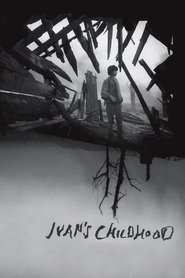
Ivan's Childhood (1962)
Tarkovsky's first feature is built across a hard seam between two utterly different visual worlds. The wartime sequences — shot by Vadim Yusov in deep-focus night photography, low angles pressing a small figure against vast threatening skies, the horizontal bands of reeds and water and mist — move forward with coiled, purposeful tension. Then, without warning or dissolve, the film cuts to sequences of an entirely different texture: slow, luminous, sun-drenched, photographed like a memory of warmth. Watch for that cut. Tarkovsky makes it as hard and flat as he can. The two worlds are not blended; they are welded at a seam, and the seam is the subject of the film.
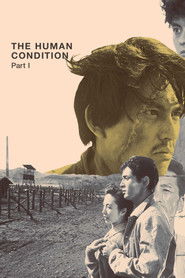
The Human Condition I: No Greater Love (1959)
Kobayashi opens his ten-hour trilogy in widescreen — GrandScope, a vast horizontal frame — and Yoshio Miyajima's photography fills it with grids: fence lines, rows of labourers, the receding geometry of the camp. Watch how the wide image works against its single protagonist. One man stands in an enormous frame, and the space around him already tells you more than the dialogue will. Miyajima also deploys long takes of unusual patience, letting scenes breathe until the social pressure inside them becomes almost physical. This is a film about a man who believes he can change an institution from within; watch the frame to see what the frame thinks of that belief.
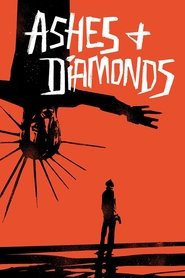
Ashes and Diamonds (1958)
Jerzy Wójcik's black-and-white photography is among the most ravishing in 1950s European cinema, and it is worth attending to as a language. Faces are half-consumed by shadow in the chiaroscuro tradition of American film noir; a source of actual flame provides moral punctuation in the dark; a ruined church interior turns a scene of rest into something that feels like an allegory. Watch how the look of the film positions its hero: Maciek wears dark glasses indoors, at night, and the deep shadows cooperate with that image. He is a man built for decisive action whose actions no longer connect to the world they were designed to change.
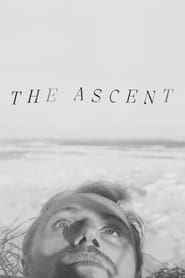
The Ascent (1977)
Shepitko's film, shot in the wintry whites and deep blacks of the Byelorussian partisan war, is one of the most visually austere pictures in Soviet cinema — and one of the most spiritually concentrated. Her declared model is Dreyer's The Passion of Joan of Arc: the martyr's face isolated in extreme close-up against a featureless sky, skin lit so it becomes almost luminous, almost haloed. Watch for those close-ups. They do not feel like conventional dramatic emphasis; they feel like an entirely different register of image, as if the film is trying to see something in the human face that ordinary dramatic cinema cannot quite access. Two partisans move through a landscape of snow and silence, and the film slowly becomes about something other than the war that occasions it.
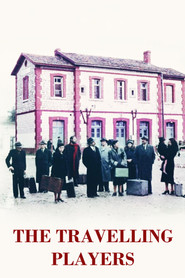
The Travelling Players (1975)
Angelopoulos and his cinematographer Giorgos Arvanitis built this four-hour film from approximately eighty long takes, some running many minutes, in which the camera drifts through provincial space — wet grey railway platforms, empty squares, muddy roads — and time changes without a cut. Watch for the shot everyone remembers: the camera follows a crowd, loses them at a corner, waits on the stone — and when people return, the banners they carry belong to a different year. Nobody told you. The street did the time-travelling. This is not a stylistic flourish; it is Angelopoulos's theory of how history actually works, smuggled inside a camera move. Space here is where time lives.
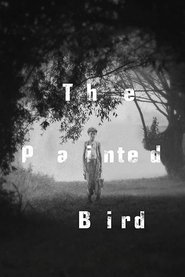
The Painted Bird (2019)
Vladimír Smutný's camera is almost always still. Where you might expect a tracking shot to follow the boy — to pull us into his movement, his escape, his point of view — the camera holds its position and watches from a distance, the boy small within a landscape that dwarfs and endangers him. This is a deliberate refusal of the identification that cinema usually offers. Wide-angle compositions, anamorphic monochrome, available light: the film is working in the visual grammar of Tarkovsky and Klimov, and it is worth knowing that lineage as you watch. The boy at the centre does not act on what he witnesses; he can only register it. The camera's stillness asks us to keep him company in that helplessness.
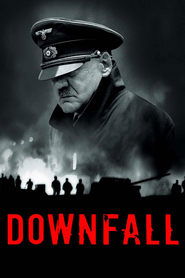
Downfall (2004)
Rainer Klausmann's camera in the bunker sequences is handheld but not frenetic — it stays close to faces, traps characters in shallow focus and narrow corridors, but without the agitation of combat journalism. The proximity creates a different kind of unease: intimacy with people you cannot leave. Watch the map-room scenes particularly. The ritual of the military briefing — situation read, orders issued — continues in perfect procedural form long after the situation has ceased to correspond to anything above ground. The film asks you to watch a system running its familiar motions in a vacuum, and Klausmann's steady, close lens is what makes that bearable and unbearable simultaneously.
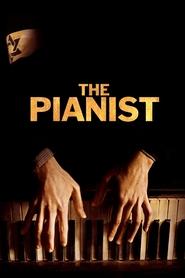
The Pianist (2002)
Paweł Edelman's palette is cool and desaturated — greys, ash, wintry light — refusing both nostalgic warmth and dramatic expressionism. The camera is steady and observing, favoring clean, legible compositions that watch rather than pursue. The crucial spatial figure to notice is the window: again and again, Szpilman is positioned behind glass, looking down at a street he cannot enter, watching events he cannot alter. That architecture of watching — the body pressed back from the threshold, the gaze aimed outward and downward — organizes the entire film. Polanski has made this geometry before, in other kinds of confinement; here it is literal, historical, and absolutely precise.
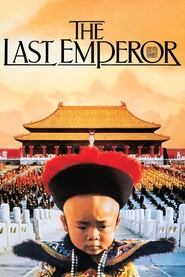
The Last Emperor (1987)
Vittorio Storaro constructs a color grammar in which each historical period has its own temperature. The sequences inside the Forbidden City are amber and gold — warm, rich, enclosed. As the film moves forward in time, the palette cools: republican greys, the bleached light of the re-education camp. Watch how this works not as decoration but as information — you can feel which era you are in by the warmth of the air before any dialogue tells you. Watch also how editor Gabriella Cristiani moves between time periods: not with hard cuts but with dissolves, so that one era bleeds into another and you lose the ability to say with certainty which time is the real one.
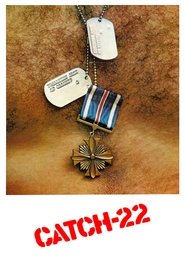
Catch-22 (1970)
David Watkin's signature choice is the long-held wide shot: the airfield at dawn, planes against an enormous flat sky, tiny human figures going about the rituals of a war that will simply continue regardless of what any individual decides. Watch for that patience — the camera that does not move to serve action because action is not quite the point. Nichols also uses time non-linearly, returning to certain images across the film whose meaning shifts with repetition. A scene you take for darkly comic on first encounter will recur in a different register. The film is teaching you, across its running time, to reread what you thought you understood.
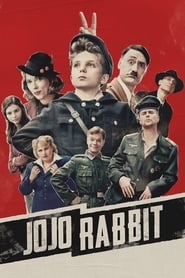
Jojo Rabbit (2019)
Mihai Mălaimare Jr.'s photography is symmetrical, bright, almost picture-book — centered framings, saturated color, a visual world as orderly and toy-like as a child's conception of it. Watch how that prettiness functions: it is not naivety on Waititi's part but a precise representation of how a ten-year-old experiencing indoctrination actually sees the world, organized and cheerful and untroubling. The imaginary Hitler who appears in this space is assembled from exactly those visual materials — poster colors, uniform geometry, nursery logic. Watch how the film gradually allows other visual registers to intrude on that brightness, and what that intrusion costs.
Watched together, these films propose something quietly radical: that the most honest way to look at war and historical violence may be to resist the grammar of heroic action entirely. Rossellini discovers it first, in the actual rubble of Rome. Tarkovsky, Kobayashi, Wajda, Shepitko, Angelopoulos, and Klimov's inheritor Marhoul each find their own version of the same truth: that the wide frame, the still camera, the figure who watches and cannot act, tells us something about these events that the rescue and the decisive blow cannot. Even the comedies — Nichols and Waititi — find their sharpest angles from stillness and helplessness rather than triumph. Watching these films in proximity rewards you not just with great images but with a new vocabulary for what images can honestly do.