Sightlines · a mini film course
When Action Fails: Watching, Waiting, and the Weight of Violence
There is a question running through every film in this set, and it isn't whodunit or even why. It is something stranger: what happens to a person — and to a story — when the expected act either cannot be performed, or is performed and changes nothing? The thriller, the Western, the gangster picture — these are genres built on a promise. A wrong is done, a capable person perceives it, they act, and the act restores some kind of order. These twelve films are united by their willingness to make that promise and then, quietly or violently, refuse to keep it. Characters watch when we expect them to move. Action arrives without grace, without resolution. Space becomes a trap. Time pools in the gaps where a cut should fall. Watching these films together, you start to notice that the most interesting thing cinema can do with genre is to let it breathe until it breaks.
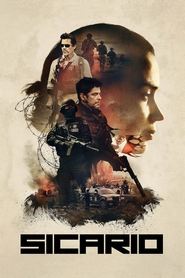
Sicario (2015)
The key is where Villeneuve keeps putting his protagonist. In doorways. In back seats. At the edge of rooms where the real decisions are being made. Emily Blunt's Kate Macer is a skilled, perceptive agent — and she is systematically excluded from every moment of consequence. Watch the convoy sequence: it is twelve minutes of tactical activity that Kate (and you) ride through without full knowledge of its purpose. Roger Deakins frames the desert as geological fact rather than mythic backdrop — human figures are dwarfed without being romanticized. The landscape isn't beautiful; it simply has no opinion about what is happening inside it. Notice too how Jóhannsson's score works: it isn't telling you how to feel so much as applying pressure, a low physical dread that arrives before anything has happened.
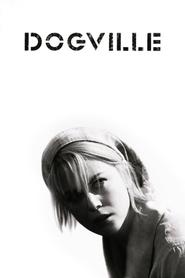
Dogville (2003)
Von Trier strips the film down to chalk lines on a black floor. The buildings of Dogville are hand-lettered labels; the dog Moses is the word "dog" painted on the ground; a door is a sound effect and an actor's wrist. Watch how quickly you stop noticing the absence of walls — and then ask yourself why. The film is training you to read rather than simply watch: to decode a gesture, a label, a mimed hinge, as actively as you'd read a page. Anthony Dod Mantle's handheld camera hunts restlessly among the actors, refusing the composed stillness the bare stage might invite. It's a strange combination — theatrical abstraction and documentary proximity — and the tension between them keeps the film from becoming merely clever. The set's bareness, it turns out, intensifies everything: with the furniture gone, what remains is the body and what the body does to other bodies.
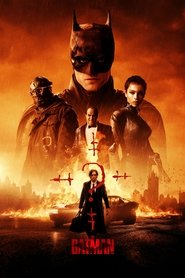
The Batman (2022)
Greig Fraser builds a Gotham that barely tolerates light. Faces fall half into shadow; the city runs on sodium-orange and deep blood-red; by blockbuster standards the film is radically, deliberately underlit — closer to Gordon Willis's work on The Godfather than to anything in the superhero canon. Watch the relationship between clue and interpretation: the Riddler constructs each crime as a message addressed to Batman, and the film's pleasures are explicitly readerly — we decode over Batman's shoulder, sharing his position as the person the killer is talking to. This is a detective film in which the mystery is almost secondary to the act of deciphering. Also watch how Reeves handles the rain: it isn't atmosphere so much as texture, a permanent condition of the world, the city permanently between one storm and the next.

Ran (1985)
Kurosawa organizes his armies by color — yellow, red, blue-green — so that battles read as abstract patterns from the telephoto distances at which he shoots them. Watch the battle at the Third Castle for as long as you can without looking away: Kurosawa cuts the sound almost entirely and plays his score over the carnage, turning what should be the film's action peak into something closer to a painting observed. Multiple cameras running simultaneously capture details no single camera could plan for — fire, smoke, the path of individual soldiers — and the editing makes no attempt to clarify the tactical picture. Chaos is the point. Notice also how Kurosawa uses color for the one character who has been stripped of everything: white, the Japanese color of death and mourning, worn by the person left with nothing to do but watch his own catastrophe.
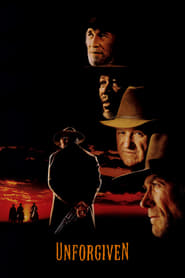
Unforgiven (1992)
Jack Green's camera opens on a silhouette at dusk — a man digging a grave, a dead tree, an orange sky — and the image is built entirely on the visual grammar of the classic Western: anamorphic width, the body dwarfed by landscape, the golden hour when myth used to arrive on horseback. But the man is burying something, not riding toward it, and that single reversal contains the whole film's argument. Watch how editor Joel Cox handles the scenes that build toward violence: he lets them go slack, lets dread accumulate in pauses where a genre cut would normally fall, so that when killing finally arrives it comes without ceremony or grace. The film keeps carefully dismantling the stories its characters — and the audience — tell about violence: what it costs, what it resolves, what it means to be known for it.
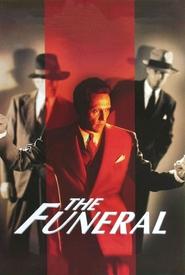
The Funeral (1996)
Ken Kelsch lights the film the way a Dutch master might have lit a vanitas painting: faces from darkness, a few practical sources, the palette running to black and cold blue. Notice that the body is present from the opening minutes — the coffin in the front room, the candles, the family arranging itself around a death rather than moving toward one. Ferrara places his ending at the beginning and asks what happens to people who already know how it ends. The film keeps interrupting its present-tense funeral with flashes of the past: earlier moments, earlier versions of these men, surfacing unbidden. Watch how those interruptions feel — not like flashbacks serving the plot, but like memories that won't stay where they belong, time refusing to move cleanly forward.
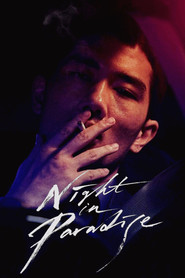
Night in Paradise (2020)
Kim Young-ho holds the camera at an unusual distance for a gangster film — wide, still compositions of Jeju's volcanic coastline, the sea large and unhurried behind figures who are anything but. Watch what that distance does to the violence when it comes: it arrives without stylistic relish, shot and edited with the same calm the landscape scenes are given, so that bloodshed and beauty occupy the same tonal register. Park Hoon-jung is interested in what happens in the aftermath of an act of revenge — not the cathartic discharge the genre promises, but the particular kind of emptiness that follows when vengeance turns out to be a door that leads to a smaller room rather than an exit. The Jeju setting is doing real work: an island is a place you go to escape, and also a place with no further out.
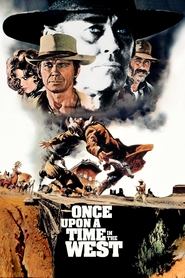
Once Upon a Time in the West (1968)
The film opens with nearly twelve minutes in which almost nothing happens. Three men wait at a train station. Watch how Leone extends that wait past comedy, past tension, into something almost geological — time itself seems to thicken. Tonino Delli Colli uses extreme telephoto lenses that compress distance and flatten landscape into abstraction, and extreme wide-angle lenses that distort faces into almost grotesque proximity; the cut between the two registers is itself a kind of violence. Ennio Morricone scores the film with themes attached to characters rather than scenes — Harmonica's motif, Jill's motif — so that the music arrives before the action does, announcing feeling as a structural fact rather than an emotional response. This is an Italian film meditating on American mythology, shot largely in Spain, and that distance from its own subject is part of what gives it such strange, elegiac clarity.
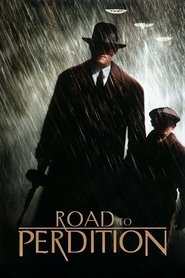
Road to Perdition (2002)
Conrad Hall — one of the great American cinematographers — works in a palette of slate, brown, and winter grey that makes the Depression landscape feel morally exhausted rather than merely poor. Watch what he does with rain: shadows of running water cross faces like tears running the wrong direction, and the film's most decisive act of violence is drained of its soundtrack until what remains is muzzle-flash on wet pavement, light rather than noise. Mendes keeps making the same formal choice throughout: pull the deed out of the chain of cause and effect, hold it at a slight remove, let it be looked at rather than simply followed. The gangster film is supposed to move; this one keeps stopping to show you what the moving costs.
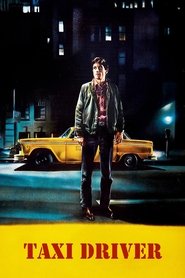
Taxi Driver (1976)
Michael Chapman's camera is intimate enough with Travis to infect you and distant enough to judge him — watch how it shifts registers: close and subjective inside the cab, windshields streaked with rain and neon, the city caught and lost in headlight beams; then suddenly outside Travis, observing from across a diner or from above, the overhead shot that turns the human figure into an object in a pattern. That oscillation is the film's central formal achievement. You are neither fully inside Travis nor safely outside him, and the discomfort of that position is deliberate. Bernard Herrmann's final score isolates and expands small musical cells rather than building to resolution — it circles, the way the cab circles, the way the film circles, proposing action and deferring it until the shape of the whole becomes visible.
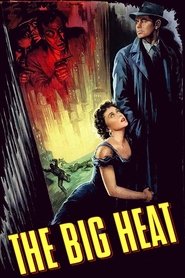
The Big Heat (1953)
Fritz Lang and cinematographer Charles Lang make constant use of thresholds — doors, windows, archways, corridors — to place characters at the boundary between safety and exposure. Watch what happens to domestic space: the Bannion house is warm and deep-focused in the early scenes, a coherent world; the spaces Bannion moves through after his loss become progressively narrower, harder, more shadowed. This is a film acutely aware of its own genre machinery — the syndicate as a vast, organized civic structure, the lone honest cop against it — and it plays that machinery straight and efficiently for long stretches. What makes it strange is the moments when it stops and simply looks: at a face that is not quite shown, at a consequence that arrives before the film says it should. Lang trusts you to do arithmetic.
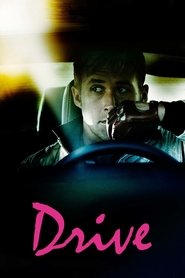
Drive (2011)
Newton Thomas Sigel shoots Ryan Gosling's face at a surveillance-camera nearness and then holds — past the point where a normal film would cut away to something else. Watch how long the film sustains that face without resolution: nothing discharges. The Driver is registered, processed, and then the film holds the registration as if waiting to see what crystallizes. Cliff Martinez's synthesizer score — in the tradition of Tangerine Dream's work for Michael Mann — doesn't underscore so much as sustain, holding a tonal color the way the face holds an expression, long past the comfortable point. When violence arrives, it shares the frame with tenderness without transition between them; Refn is interested in the moment after the shot would conventionally cut away, the texture of things rather than their function.
Why These Twelve Together
Watched in sequence, these films begin to reveal a shared grammar that cuts across genre, era, and national origin. Each one is working with the conventions of violent genre cinema — the thriller, the Western, the gangster picture — and each one finds a specific formal strategy for pressing on those conventions until something gives. Sometimes it's the pacing: Leone and Refn and Night in Paradise stretch time until waiting becomes its own kind of experience. Sometimes it's the framing: Deakins and Kelsch and Hall use light and landscape to make action feel small against the spaces it occupies. Sometimes it's the editing: Cox and Mendes and Ferrara let scenes breathe past their comfortable length, let consequences accumulate without discharge. What they all share is a deep interest in the weight of what genre cinema usually treats as weightless — the moment before the act, the moment after, the face that registers and does not move. You will finish these films knowing something about violence that most action cinema is specifically designed to prevent you from knowing.