Sightlines · a mini film course
The Blade and the Long Look: Ten Ways of Watching a Sword Fall
Nearly every film in this set has a sword in it — but that's the least interesting thing they share. What connects them is a question of how a camera behaves around violence and consequence. Some of these films chase the action; others stand back and let it arrive like weather. Some flood the screen with color so a feeling registers before a thought does; others drain the world to white grass, black hair, and torchlight. And several of them — made decades and countries apart — quietly borrow from each other: a color-coded army here becomes a color-coded memory there; a camera tilted into the sun in 1950 gets tilted into the sun again in 1964. Watched together, these ten films become a conversation across time about what a body can do, what a landscape wants, and whether the camera should be a participant or a witness.
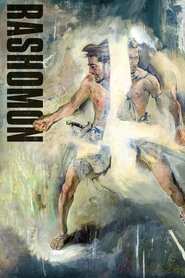
Rashomon (1950)
Watch the light. Cinematographer Kazuo Miyagawa aimed his camera straight up through the forest canopy into the sun — something studio orthodoxy forbade — bouncing the light off mirrors to hold the exposure. The result is a forest of glare, dapple, and partial visibility: before anyone tells a story, the image itself has stopped feeling trustworthy. Four people will describe the same event, and the film shoots each account with equal conviction. Notice how it refuses to hand you a referee.
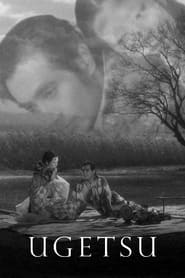
Ugetsu (1953)
This is the film of the long, gliding take. Miyagawa (again) moves the camera laterally through space without cutting, surveying rather than penetrating, so that events accumulate inside a single unbroken breath. Watch especially for moments where one continuous camera movement carries you between the everyday and the impossible without any visible seam — the film's dreamlike power lives in that refusal to cut.
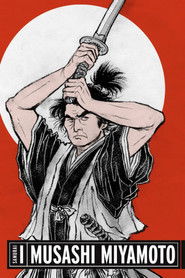
Samurai I: Musashi Miyamoto (1954)
Watch the cedar forest: Kazuo Yamada films the grove as vertical bars slicing the frame into narrow columns, with a wild young man crouched among them like a caged animal. The film prefers mid-to-long shots that hold figures inside landscape rather than fragmenting them into close-ups — a compositional calm inherited from Japanese pictorial tradition. The whole picture is about whether raw energy can be shaped into a person, and the framing does half the arguing.
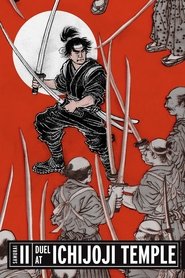
Samurai II: Duel at Ichijoji Temple (1955)
Everything here funnels toward one night below a temple — and the film wants you to feel the funnel. Watch the low torchlight against a dark field: pools of amber isolating one man while numbers gather in the surrounding blackness. Notice, too, that the story's real subject isn't the fight but the choice to walk toward it — pride and discipline pulling in opposite directions inside the same body.
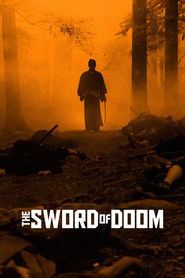
The Sword of Doom (1966)
Watch Tatsuya Nakadai's face — or rather, watch what isn't in it. He plays a master swordsman as pure vacancy, eyes clinically blank, and the film's disciplined widescreen framing keeps offering you that emptiness like a question it won't answer. Where most sword films give killing a motive, this one presents a man whose skill is powered by the absence of one. It's part of the 1960s "dark samurai" wave that turned the genre against its own heroic assumptions.
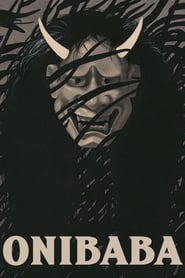
Onibaba (1964)
Start with the grass. Kiyomi Kuroda puts the camera low, under the susuki reeds, so the churning silver field fills the widescreen frame and closes over you — the landscape is not a setting here but a hungry protagonist. Notice how the film strips the period drama of heroism and the ghost story of decorum: war reduced to scavenging, desire as a leveling force. (And note the lineage: Kuroda's light raking through wild grass descends directly from Miyagawa's sun-through-foliage in Rashomon.)

Kwaidan (1965)
Look up in "The Woman of the Snow": eyes have been painted into the sky. Kobayashi never pretends to show you the world — he shows you a picture, laid out like a horizontal painted scroll, with figures flattened against designed backgrounds in saturated, deliberately unnatural color. Watch how rarely a cut fragments an action; instead each cut reveals a new tableau. It's a ghost film that generates dread through stillness and artifice rather than shock.

Ran (1985)
Watch the colors move across the landscape: Kurosawa assigns each of three armies a primary hue — yellow, red, blue-green — legible from a great distance, while the old warlord at the center is stripped down to white. Then watch for the moment the sound design does something extraordinary: battle rendered with no natural sound at all, only mourning orchestra, while smoke pours up the frame. It's a director in his seventies turning his own genre inside out — the man of action becoming a man who can only watch.
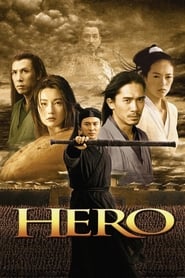
Hero (2002)
The most direct descendant of two films above: it borrows Rashomon's architecture of contradictory retellings and hires Ran's costume designer, Emi Wada, for its color-divided formations. Christopher Doyle bathes each version of events in a single hue, so you feel the story change in your body before you reason it out — watch for the golden grove that floods to red at the instant grief arrives. Nothing in the plot turns those leaves; a feeling does.

The Last Samurai (2003)
Watch how John Toll photographs landscape as an emotional register — painterly light, mist, the village as a coherent moral world — and then watch the battle staging quote Kurosawa directly: the massed cavalry against entrenched gunfire from Kagemusha, the rain-and-mud communal defense from Seven Samurai, the static wide banners-across-landscape framing of Ran. Having just seen those films, you'll recognize the borrowings on sight — and can judge what Hollywood keeps and what it changes when it looks toward Japan.
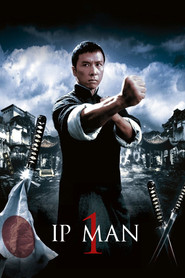
Ip Man (2008)
Notice the patience. The film spends most of an hour watching a master decline to fight — lamplight, latticed windows, warm shallow interiors — so that when violence finally arrives it feels like a circuit closing, not a spectacle beginning. Watch how the visual grammar shifts as history darkens: golden domestic light giving way to something colder and more open. The choreography, built on Wing Chun's economy of simultaneous defense and offense, makes restraint itself the style.
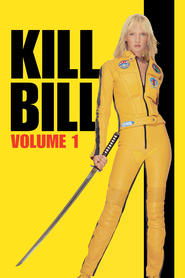
Kill Bill: Vol. 1 (2003)
Come to this one last, because it's the collector's cabinet where much of the above ends up. Tarantino builds a film almost entirely out of climactic, posed images — the stylized geyser of blood, the ritual stillness before a duel, the standoff stretched until time itself seems to freeze — and nearly every pose is a quotation: the chaptered revenge structure and snow-against-blood contrast from Lady Snowblood, Bruce Lee's yellow tracksuit from Game of Death, hard cuts on the blow from The Street Fighter. Watch Robert Richardson's signature top-light haloing hair and shoulders, giving even grimy rooms a graphic crispness. The pleasure here is density: a whole film made of peaks, each citing the peak it descends from.
Watch these together and something rare happens: you start seeing the films inside the films. Miyagawa's sunlight resurfaces in Kuroda's grass; Kurosawa's color-coded armies march again in Hero and charge again in The Last Samurai; the ambiguity Rashomon invented becomes the architecture Zhang Yimou paints in gold and red; and Tarantino gathers half the tradition into a single ecstatic scrapbook. You'll also notice two opposed temperaments arguing across the whole set — cinema that poses (Kwaidan's tableaux, Kill Bill's frozen climaxes) and cinema that witnesses (Ugetsu's gliding camera, Ran's silent catastrophe) — and you'll find that the greatest of these films know how to do both. By the tenth film, you won't just be watching sword fights. You'll be watching a century-long conversation about how a camera should stand in the presence of consequence.