Sightlines · a mini film course
When the Camera Starts Thinking: A Course in Films Where Seeing Is the Story
Most movies work like machines: a character sees a problem, acts, and the world changes. The eleven films on your list all, in different ways, break that machine on purpose — and what rushes into the gap is seeing itself. In these films the camera watches rather than chases. Rooms and corridors stop being backdrops and start behaving like states of mind. Mirrors stop reassuring. Time is allowed to stretch until you can feel it. Watch them with one question in your pocket: what does the image know that the person inside it doesn't? Presented in rough chronological order, so you can watch the idea evolve across six decades.
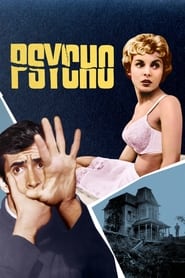
Psycho (1960)
Notice how relentlessly this film is organized around looking — who looks, through what frame, and what it costs. Its heroine is watched from the moment she appears: by a boyfriend, a boss, a highway patrolman staring wordlessly through a car window — and Hitchcock quietly makes you one of the watchers. Shot fast and clean by a television cameraman rather than a prestige crew, its stripped-down black-and-white look was a deliberate step down in glamour, and it changed horror forever. Pay attention to a slow spiral of water down a drain: the film's whole design pivots on images like that.
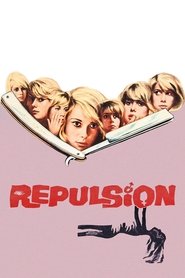
Repulsion (1965)
Here a South Kensington flat becomes a mind you're locked inside. Almost nothing "happens" in the conventional sense — instead, watch things decay: dishes pile up, a skinned rabbit sits uncooked on a plate day after day, a crack branches across the plaster. Polanski borrows Hitchcock's trick of pairing extreme close-ups with amplified everyday sound — drain water, buzzing flies — so that horror comes from textures, not events. Ask yourself, room by room, whether the apartment is changing or the woman inside it is.
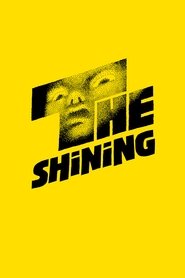
The Shining (1980)
The brand-new Steadicam was invented to smooth out shaky shots; Kubrick turned it into a way of thinking. Watch how it glides inches off the floor behind a boy on a tricycle — carpet, hardwood, carpet, the wheels going loud, soft, loud — so that you brace before every corner. Notice too the rigorous symmetry, corridors receding to a single vanishing point, and the bright, oddly natural light: this hotel is rendered with total clarity, and it still doesn't add up. Viewers have tried for decades to map the Overlook's geography and failed. That failure is the design.
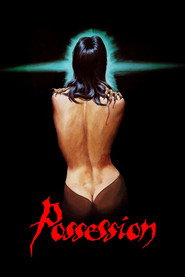
Possession (1981)
The camera here behaves like an anxious participant, not an observer: wide-angle and close, circling the actors, swinging after sudden movement, turning domestic rooms into pressurized boxes. Żuławski directed his performers to the edge of physical collapse, and the result is acting that becomes something else — bodies undergoing rather than performing, sustained at an operatic pitch that's a system, not an accident. Made in exile in West Berlin by a Polish director cut loose from home, it fuses marital-breakdown drama, body horror, and Cold War thriller into something with no clean category. Don't try to steer it. Endure it, the way the camera does.
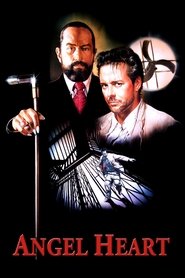
Angel Heart (1987)
A private-eye film crossed with occult horror, shot through smoke and dust so highlights bloom and shadows swallow detail — cold grey New York against humid, amber, rotting Louisiana. Watch the ceiling fans: there's one slowly chopping the light in almost every room, and the hero keeps not looking at it. The film also seeds near-invisible flash-cut images into otherwise naturalistic scenes, a trick learned from The Exorcist. This is a movie where the image knows more than the man inside it — enjoy the gap.
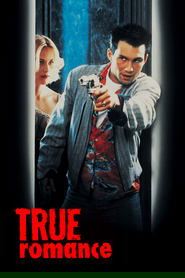
True Romance (1993)
The warmest film on the list, and secretly about the same thing as the others: a self built entirely out of images. Clarence has assembled himself from comic books, kung-fu movies, and Elvis — and when Elvis appears in his bathroom mirror to give advice, Tony Scott shoots it dead literal, no wavy dream signals, completely unembarrassed. Watch the color — bruised blues and molten ambers pushed toward abstraction — and the way extreme tenderness and extreme violence sit in the same frame without apology. It's the lovers-on-the-run picture rebuilt for kids raised on screens.
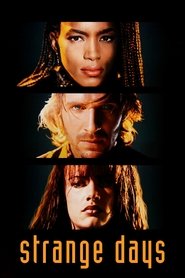
Strange Days (1995)
Bigelow's near-future noir runs on two kinds of image, and learning to tell them apart is the pleasure. There's the "real" Los Angeles — wet streets, sodium light, permanent night — and then there are the clips: unbroken first-person recordings of someone else's full experience, which you don't watch so much as wear. Built on custom rigs years before GoPro, VR, or bodycam footage existed, these sequences ask an uncomfortable question the film takes seriously: what does it make you, to relive someone else's sensations? Notice how it feels each time the film hands you borrowed eyes.

Dark City (1998)
Pure inherited nightmare: the painted shadows and looming silhouettes of silent German cinema, the stratified miniature metropolis of Metropolis, all pressed into 1990s tech-noir. The light is hard, low, and sourced — lamps, neon, shafts through blinds — carving figures out of near-total darkness, with the camera restless, canted, craning through vertical space. Watch what the city itself does when the clock strikes twelve, and hold onto the two words everyone in the film can say but no one can explain: Shell Beach.

Black Swan (2010)
Watch the back of her head. The camera rides inches behind Nina's shoulder through corridors and dressing rooms, never letting you see quite what she sees, never letting you stand safely apart — intimacy curdled into surveillance. Then watch the mirrors, because the film can't stop: a ballet studio walled in glass, reflections that seem to lag a half-beat behind the body that cast them. Its family tree runs straight through Repulsion, The Red Shoes, and the animated Perfect Blue — a whole tradition of films where a woman's surroundings become her nervous system.
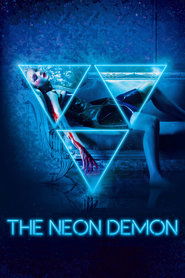
The Neon Demon (2016)
The very first image teaches you how to watch: a beautiful girl posed as a corpse, blood that turns out to be paint, a photographer stepping in to fix her hair. In this Los Angeles, being looked at and being consumed are nearly the same act, only at different speeds. Refn borrows Suspiria's saturated gel lighting and the fashion-house menace of Italian horror, and notice how little anyone does