Sightlines · a mini film course
When the Camera Knows More Than the Cop: Crime, Guilt, and the Limits of Action
What connects these eleven films isn't a shared setting or a shared decade — it's a shared suspicion. Each one takes the machinery of the crime film (the chase, the investigation, the showdown, the revenge) and asks what that machinery actually costs, or conceals, or can't deliver. Some of them trust their heroes just enough to show us why they shouldn't. Some drain the catharsis out of violence until what's left is closer to grief than satisfaction. All of them use the camera — its speed, its stillness, its angle, its patience — as the real moral instrument. Watch the films in sequence and you'll start to feel how each one inherits a question the last one left unanswered.
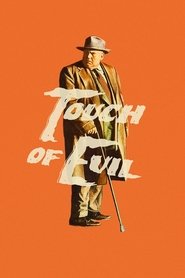
Touch of Evil (1958)
Before the first cut arrives — before anything is established, named, or explained — Orson Welles and his camera are already moving, threading through three unbroken minutes of traffic and neon and competing music, tracking a car with a ticking bomb in its trunk through a border town that feels genuinely alive in every direction the frame can't quite reach. Hold that opening image beside the first shot of Hank Quinlan: a mountain of a man photographed from floor level, ceiling pressed down on his head, chewing a candy bar where another man would take a drink. The camera that opens the film is incapable of lying; the cop at its center is incapable of stopping. That tension is the whole film. Watch how Welles and cinematographer Russell Metty almost never cut when they can instead pull an actor toward or away from the wide-angle lens — closeness becomes a kind of accusation. The distortion isn't decorative. Every wide-angle grotesque is a moral reading.
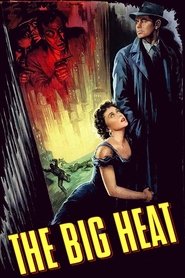
The Big Heat (1953)
Fritz Lang's syndicate thriller is the cleanest example in this collection of cinema as a cause-and-effect machine running at full efficiency — and the most precise demonstration of what that machine costs the people inside it. Watch how cinematographer Charles Lang uses doorways, windows, and archways to place characters at the exact threshold between safety and danger: the Bannion home is filmed with warm depth and breathing space; every room thereafter gets narrower. Notice also Lang's patience with Debby Marsh — the first time we see her after a scalding, she enters with her coat collar turned up, and Lang lets you do the arithmetic before he confirms it. That trust in the audience's dread is the mark of a filmmaker who understands that the worst thing is most powerful when it arrives a half-second after you've already imagined it.
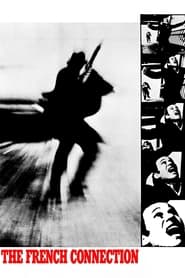
The French Connection (1971)
William Friedkin's procedural begins with a study in cold. Doyle is on a Brooklyn sidewalk in December, stamping his feet and eating bad pizza; through the restaurant window across the street, the man he's hunting is turning a fine meal over a white tablecloth. Friedkin doesn't explain the image. He just puts you on the cold side of the glass. Cinematographer Owen Roizman shoots the whole film in the visual grammar of surveillance — long telephoto lenses that flatten and compress, available light that flatters nobody, a palette of greys and institutional greens that refuses to make New York glamorous. The camera doesn't celebrate Doyle; it watches him the same flat way it watches everything else. Pay attention to what the film allows him to get wrong, and what those mistakes cost people who aren't him.
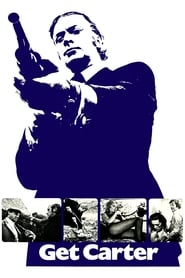
Get Carter (1971)
Made the same year as The French Connection and its precise British counterpart — same bleakness, same refusal of glamour, entirely different landscape and emotional register. Jack Carter arrives in Newcastle by train, and cinematographer Wolfgang Suschitzky photographs the journey with a flat, almost photojournalistic patience: terraced roofs, slag heaps, the weak northern light that refuses to make anything look better than it is. Carter himself is controlled, watchful, professionally capable — and the film is very careful not to let his competence feel like heroism. Notice how Suschitzky consistently places Carter as a figure within the industrial landscape rather than above it: the quayside, the multi-storey car park, the black spoil-beach. The geography isn't backdrop. It's a destination the film has known about from the first frame.
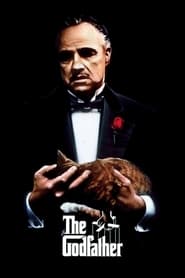
The Godfather (1972)
The film begins in a room so dark you can barely see the man holding power in it. Gordon Willis lit Marlon Brando from almost directly above, flooding the eye sockets with shadow, so that the most powerful figure in the film is also the least readable. That single lighting decision — withhold the eyes — instructs everything that follows. Willis's darkness isn't atmosphere; it's argument. Watch how the quality of light shifts as the film proceeds and as its moral landscape changes: some of the most consequential spaces in the film have had their light deliberately taken away. Notice also Coppola's relationship to ceremony — the wedding that opens the film, the baptism sequence late in it — and how ritual is used to make transformation feel both inevitable and terrible.
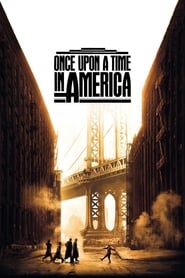
Once Upon a Time in America (1984)
Leone's film announces its relationship to time in the first minutes and never lets you forget it. Where most crime films use their structure to build toward revelation, this one keeps folding its timelines back on themselves so that the past is always pressing through the present like something that won't stay buried. Cinematographer Tonino Delli Colli distinguishes the eras through light and color temperature: the childhood and Prohibition sequences carry amber warmth, almost honeyed; the 1968 sequences are cooler, more exposed, the light of a man who has run out of places to hide from what he knows. Equally crucial is Ennio Morricone's score, which Leone had composed before shooting began — the music doesn't illustrate the images; the images were built to inhabit the music. Listen to what the score is doing emotionally in scenes where the characters are saying almost nothing.
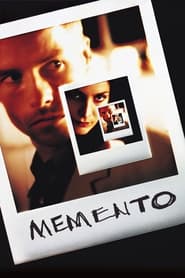
Memento (2000)
The practical effect that announces Christopher Nolan's structural conceit is a Polaroid photograph running in reverse — an image draining back into blankness rather than developing into fact. It lasts about three seconds and contains the whole film. Nolan's formal invention is to build the film's color sequences in reverse chronological order, each scene ending where the previous one began, so that you arrive in every scene with no memory of how you got there — the same position as the protagonist. Wally Pfister's cinematography is deliberately restrained given how much the structure already demands of you: clarity over flourish, the visual field kept legible so the cognitive weight lands where it belongs. Pay attention to the two different visual registers — color sequences running backward, black-and-white running forward — and where they meet.
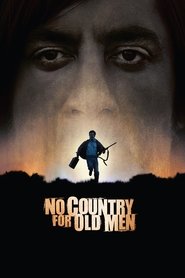
No Country for Old Men (2007)
Roger Deakins photographs the Texas landscape not as beauty but as exposure: long lenses that compress figures against featureless desert, emphasizing how small a person is against that much open space, how far away help would be. Interior sequences go the opposite direction — small rooms, dim light, ambient sound doing the work that music usually does. The Coens have stripped the score almost entirely away, so what you hear in the tensest scenes is what you would actually hear: air conditioning, distant traffic, the specific silence of a motel corridor at two in the morning. Notice what the film does with its genre obligations — the chase, the pursuit, the narrowing net — and how each one is honored and then quietly, methodically refused its expected payoff.
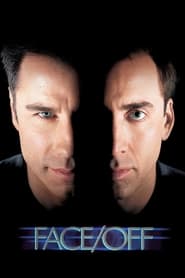
Face/Off (1997)
John Woo's film is operatic in a very precise sense: it takes emotions that most action films hide under speed and noise and instead slows them down, makes them large, frames them formally. Watch for the recurring use of mirrors, reflective surfaces, and symmetrical compositions that place the two leads as each other's doubles — Oliver Wood's widescreen camera keeps finding arrangements that suggest two versions of the same figure rather than two different men. The dove imagery and the chapel sequences come directly from Woo's Hong Kong films; they function here not as decoration but as the film's announced emotional register, a claim that what looks like a thriller is actually closer to a tragic ballad about identity and loss. The slow-motion gunfights are not about spectacle — they're about grief made kinetic.
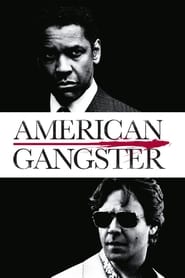
American Gangster (2007)
Cinematographer Harris Savides built the film around a chromatic argument: Frank Lucas's world is warm — amber, fur, the ordered luxury of self-made wealth — while the detective's world is grey, institutional, cold. This isn't glamorising one and condemning the other; it's showing you two systems in parallel, each internally coherent, each with its own logic and its own costs. Watch what Ridley Scott does with clothing — particularly the single choice Lucas makes that changes everything — as a way of reading power. And watch the Thanksgiving table, and the family gathered around it, as a kind of geometry: the gangster as patriarch, domestic space as the real center of the criminal enterprise, ordinary love and catastrophic violence sharing the same square footage.
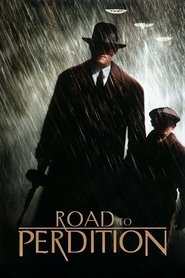
Road to Perdition (2002)
Conrad Hall's final film as cinematographer works in a near-monochrome palette — slates, blacks, the cold blue-grey of Depression winter — that makes the landscape feel morally exhausted before anyone has done anything wrong. Hall was famous for a specific technique: letting shadows of running rain cross a character's face so that grief appears to be projected onto them from outside, as if the world is weeping rather than the person. Watch for it here, and watch how Mendes repeatedly stages acts of violence at a formal distance — pulled back, held still, drained of immediate noise — so that what should feel like release instead feels like weight. The film is interested in what gets handed down from father to son without anyone choosing it.
Why Watch Them Together
Seen one at a time, each of these films is a genre achievement. Seen together, they become a conversation across seven decades about a single question: what does it mean to act — to pursue, to avenge, to enforce, to protect — in a world where action keeps producing consequences nobody intended and justice keeps arriving in the wrong shape, or not at all?
The earliest films here — The Big Heat, Touch of Evil — still believe in the machinery of cause and consequence, but they're already bending it, already showing the costs. By the time you reach No Country for Old Men or Once Upon a Time in America, the machinery has been quietly disassembled; characters pursue and pursue and the situation doesn't resolve, it just deepens. And scattered through the whole sequence are films — Drive, Memento, Face/Off — that turn the camera inward, making the form of the film itself carry the argument rather than leaving it to the plot.
What every one of them shares is this: a filmmaker who understood that the crime film's real subject was never the crime. It was always the person watching, and what they were willing to see.