Sightlines · a mini film course
The Watchers: Twelve Films Where Looking Becomes the Event
Most movies run on a simple engine: a character sees a problem, acts, and the action carries us forward. The twelve films on your list all, in their different ways, switch that engine off. Their people are exiles, dreamers, grievers, artists gone quiet — figures who can see everything and do almost nothing about it. So the films find another source of power: duration itself. The camera watches rather than chases. Time is allowed to stretch until you can feel its weight. The line between the world and the head grows thin, sometimes invisible. Watch these films not for what happens next, but for how they teach you to look — and how strange and moving pure looking turns out to be.
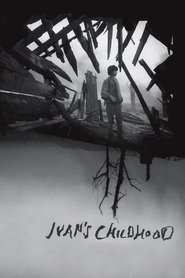
Ivan's Childhood (1962)
Tarkovsky's first feature is built across a fault line: tense, deep-focus night photography for a boy's wartime missions — reeds, water, mist, small figure against huge threatening skies — and something radiantly different for his dreams. Watch how the film cuts between the two: flat, hard, no dissolve, no consoling music. That refusal of a soft seam is the whole story told as technique. Notice, too, how the dreams explain nothing about the plot; they exist for their own sake, which was radical in a Soviet war film.
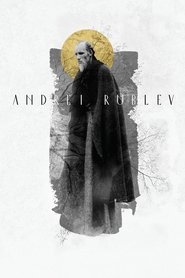
Andrei Rublev (1966)
A three-and-a-half-hour film about a painter who spends most of it watching. The long takes refuse to cut away from discomfort or to punctuate a revelation with an edit — the camera moves, but it accompanies rather than dramatizes. Watch the astonishing prologue, a man and a makeshift balloon, and notice what the scene doesn't do: no rescue, no cut to spare you. The question the whole film asks — what art costs, and whether it can be made in terrible times — is asked by the camera's patience before it's asked by any character.
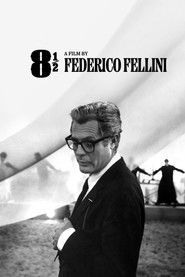
8½ (1963)
Fellini's great innovation here is the missing seam. Ordinarily a film warns you when it leaves reality — a dissolve, a shimmer, a change of music. 8½ cuts from the present to memory to fantasy with the same hard, matter-of-fact join it uses between two rooms of a house, all shot on the same gorgeous black-and-white stock. Watch the opening minutes closely: they teach you the rule the rest of the film will keep, and once you accept it, the film becomes exhilarating rather than confusing.
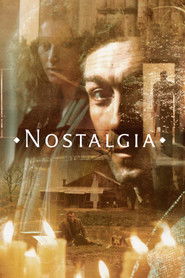
Nostalgia (1983)
Tarkovsky in Italian exile, making a film about exile. The camera moves slowly — lateral drifts, gentle pushes forward — building pressure through sheer duration instead of editing. There is a famous sequence involving a candle and a drained pool that is one unbroken shot, and its precariousness is real, not simulated: by the end you've stopped watching a task and started watching time itself become an act of devotion. Notice how the two main characters, speaking different languages, fail to connect — the film's argument is that inner life itself is a homeland no one else can visit.
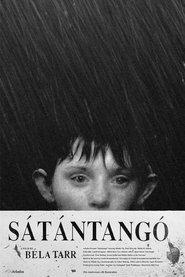
Satantango (1994)
Seven hours, black and white, rain, mud, and some of the longest single shots in narrative cinema — five, eight, ten minutes without a cut. The opening take, several minutes of cattle wandering a ruined farmyard, is Tarr's tutorial: he is recalibrating your inner clock before the story begins. Watch how waiting becomes the film's true subject — a village of people watching each other wait — and how, an hour in, that pace stops feeling slow and starts feeling like habitation. It's the endpoint of the tradition Tarkovsky started, taken further than anyone.
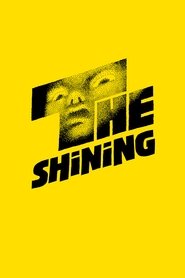
The Shining (1980)
Kubrick took the brand-new Steadicam — invented to smooth out shaky shots — and turned it into a way of thinking: the camera glides inches off the floor behind a boy on a tricycle, through corridors composed in perfect one-point perspective. Listen as much as you look — carpet, hardwood, carpet, the wheels going loud and soft as he rounds each corner. And try, if you can, to map the hotel. Its geography is famously, deliberately impossible: the building isn't a setting the characters move through so much as a mind they're moving inside.
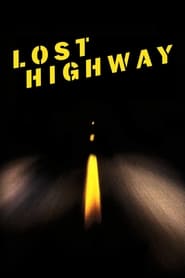
Lost Highway (1997)
Lynch and cinematographer Peter Deming shoot a house as engulfing darkness — rooms defined by what you can't see, people walking into blackness and dematerializing — set against bleached, sun-struck exteriors. The film has all the furniture of noir (the mysterious woman, the gangster, the surveillance tapes) but strips out motive, explanation, and detection. Watch how it handles doubling — of faces, of spaces, of moments — and notice that it never gives you the cut that would settle what's real. That refusal is the design, not a flaw.
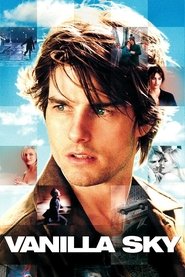
Vanilla Sky (2001)
John Toll, one of the great painterly cinematographers, gives this film a lush, high-gloss beauty — and that beauty is a clue, not decoration. Watch the celebrated early image of a completely empty Times Square: the film shows you something too gorgeous to trust before it tells you anything is wrong. It's a Hollywood reworking of a Spanish film, part of that turn-of-the-millennium wave of "is this world solid?" stories, and Crowe's meticulously curated soundtrack works as a second narrator throughout. Stay alert to surfaces — the film is about the seduction of a perfect image.
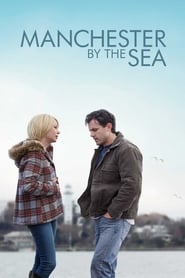
Manchester by the Sea (2016)
Lonergan and cinematographer Jody Lee Lipes shoot New England winter with a plainness that reads as moral: steel-grey light, still frames, a camera that holds on faces and lets scenes breathe. This is a grief film that refuses the usual engine — loss here doesn't become a quest or a reckoning; it's a season to be endured, and the film has the nerve to wait it out. Watch how the past arrives without announcement, cut into the present with no visual warning, and watch Casey Affleck do almost everything by doing almost nothing.
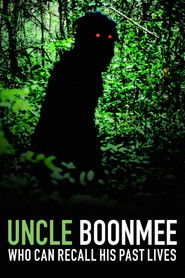
Uncle Boonmee Who Can Recall His Past Lives (2010)
A patient, largely static camera; interiors lit to preserve real darkness; long takes that hold well past the point where a conventional film would cut. The film's most famous scene is a family dinner at dusk where the impossible arrives by slow degrees — and nobody screams, nobody explains, food is simply passed. That calm is the innovation: wonder without a music sting, the supernatural treated as a guest. Let the jungle sound design be your score; there barely is another one.
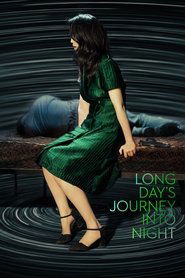
Long Day's Journey Into Night (2018)
Bi Gan's film is two kinds of cinema welded together, and it tells you so with a physical instruction: an hour in, the title card finally appears and you're asked to put on 3D glasses — at which point the film enters a single unbroken shot lasting nearly an hour. The first half is memory that refuses to behave like memory, fragments that won't anchor to a timeline; the second is something you feel rather than parse. Watch for the debt to Tarkovsky's drifting voiceover and to noir's rain-slicked yearning — and enjoy being made complicit in putting on a dream.
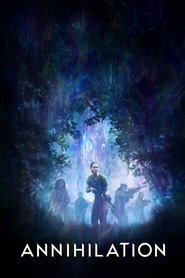
Annihilation (2018)
Garland and cinematographer Rob Hardy render the film's mysterious zone as a soap-bubble membrane — greens pushed toward the toxic, light given an oily refraction — a direct descendant of Tarkovsky's forbidden Zone in Stalker. Watch the moments when the expedition simply stops and stares: a pair of deer moving in perfect mirrored unison, unexplained, unresolvable. These are competent, armed, scientific people, and the film keeps giving them things nothing can be done about. The horror here isn't attack; it's transformation — and the finale trades dialogue for pure image and sound.
Watched together, these films form a single long lesson in a different kind of attention. Start with the Tarkovskys and you'll see the source code — the long take as patience, the dream cut flat into the day — then watch it flow outward: into Tarr's seven-hour endgame, into Bi Gan's unbroken hour, into Garland's shimmer, all of which openly borrow from Stalker and Mirror. Fellini, Lynch, and Crowe run the same current through the head instead of the landscape, dissolving the seam between lived and dreamed; Kubrick builds the dream as architecture; Lonergan and Apichatpong prove that pure watching can hold a family's grief as surely as a war or a haunted hotel. The reward for the viewer is a retrained eye. After a week inside these films, an unbroken shot stops feeling slow and starts feeling charged — nothing happening, everything at stake.