Sightlines · a mini film course
The Camera That Watches: Ten Films on Power, Performance, and the Untrustworthy Image
What binds this set together — eight Kurosawas, plus kindred spirits from Mizoguchi, Kinugasa, Zhang Yimou, and Wilson Yip — is a shared fascination with seeing. Who gets to look, who is forced to watch, and whether what the camera shows us can be believed at all. These films range from muddy black-and-white battle epics to screens flooded entirely in red or gold, but they keep circling the same questions: identity as a performance you can put on like a robe; the past refusing to stay buried; violence as something the world demands rather than something a hero chooses. Watch them together and you'll see a whole conversation unfold — filmmakers borrowing each other's tricks, arguing with genre conventions, and slowly teaching you to distrust the beautiful images they hand you.
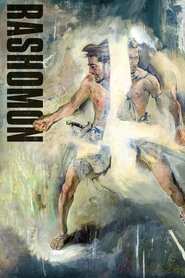
Rashomon (1950)
Start here, because everything else in this set answers to it. Cinematographer Kazuo Miyagawa did something studio orthodoxy forbade: he aimed the camera straight up into the sun, bouncing light off mirrors, so the forest itself flickers and dazzles and goes briefly blind. Notice how the site of the crime is always partially obscured — branches between lens and subject, glare swallowing the frame — so that before anyone tells a lie, the image itself has stopped being trustworthy. Four testimonies, one dead samurai, and a film that refuses to hand you the true version. Watch how each account is shot to feel completely coherent while you're inside it.

Seven Samurai (1954)
Watch for the moment Kambei crouches and scratches a map of the village into the dirt — the battle exists as a diagram before a single arrow flies. Kurosawa shoots the first half like a class portrait: samurai framed against sky and high ground, farmers clustered low to the earth. Then the fighting comes, and he strips the sword film of its choreographed elegance, replacing it with mud, rain, fatigue, and multiple cameras running simultaneously so no take ever has to stop for coverage. The village isn't a backdrop; it's practically a character, an environment so charged it seems to summon the action out of the men.
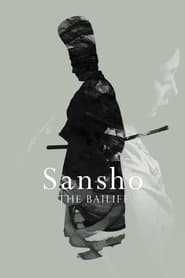
Sansho the Bailiff (1954)
Mizoguchi is Kurosawa's great opposite: where Kurosawa's camera plunges in, Mizoguchi's holds back. Watch for the film's most devastating moments played out at a distance — the camera refusing to cut close, refusing to console you with a reaction shot, letting silvered mist and still water carry the feeling instead. His signature is the long, gliding take that tracks and cranes like a hand-scroll unrolling, drawing one continuous line through a scattered family's severed lives. What arrives sideways, through patience and distance, hits harder than any close-up could.
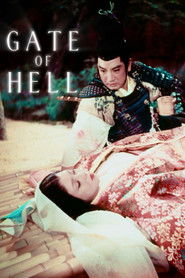
Gate of Hell (1953)
The first thing to watch is the color — this film helped invent the idea that a palette could be the drama. Sugiyama builds interiors from harmonized neutrals so that a single robe or curtain lands like a struck bell. But the deeper thing to track is the portrait of obsession: Moritō doesn't fall in love so much as get seized, and the film presents his fixation without excuse — less a courtship than a symptom, appetite using a man to pursue its own satisfaction. Notice how the film's painterly beauty and its moral seriousness pull against each other.
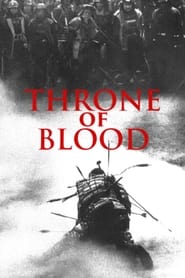
Throne of Blood (1957)
Kurosawa filters Shakespeare through Noh theater: faces held in mask-like stillness, figures pinned front-center or pushed to the edges, negative space that presses like a weight. The Cobweb Forest sequences are the ones to savor — riders galloping through fog and emerging at the same spot, every clearing identical, no horizon, no landmark. Space itself becomes a trap: motion no longer takes you anywhere, only deeper in. And watch Isuzu Yamada's Asaji, whose terrifying immobility owes something to the great silent-era close-ups of psychological collapse registered without expression.
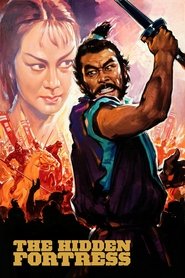
The Hidden Fortress (1958)
Kurosawa's first full embrace of the wide anamorphic frame, composed like a landscape painter's canvas — peasants in the foreground, troops in the middle distance, mountain ridgelines behind. The masterstroke is perspective: we're pinned to the height of two bickering, greedy, perpetually wrong peasants, seeing partially, from below, from the dirt. Notice how disguise works here — the princess passes as a commoner only because the social order makes actual commoners invisible. A rollicking adventure that's secretly a lesson in how a film controls what you're allowed to know.
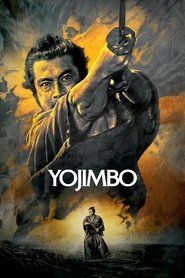
Yojimbo (1961)
Watch what the nameless ronin actually does most of the time: he watches — from a watchtower, a rooftop, a sake barrel — assessing, withholding, selling himself to each faction while never quite belonging to any. Asked his name, he invents one from a mulberry field glimpsed through a window; hold onto that joke, because it tells you how the film thinks about identity. Miyagawa trades his lyrical Rashomon lighting for harsh daylight and suspended dust, and Kurosawa grafts American hardboiled crime plotting onto the samurai film — a hybrid that was unprecedented in Japanese popular cinema.
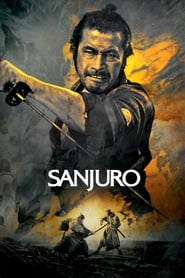
Sanjuro (1962)
The sequel's real dialogue is conducted in posture. Nine young samurai kneel in tight formation, spines like drawn bows — and the man they've staked their lives on slumps against the wall, scratching, yawning, picking at fleas. Every Mifune slouch is timed to puncture a specific pomposity nearby, while Tatsuya Nakadai's rival keeps violence folded inside total stillness. The film's argument — the gap between looking correct and being good — is acted out in muscle before anyone says it aloud. Once you read the bodies, the comedy stops being decoration.
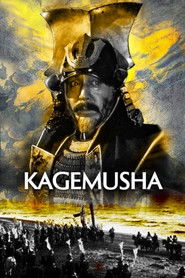
Kagemusha (1980)
The opening is one of the boldest declarations in Kurosawa's career: three men, identically dressed, seated in a single unbroken static shot held so long you start hunting for the difference between them. One is a warlord; one is a thief who happens to share his face. Watch how the film treats identity as something performed and sustained — a nobody holding an army together through sheer continuity of posture. This is also where Kurosawa prototyped the color-coded army system, each clan legible by banner and costume hue, that he would perfect in his next epic.

Ran (1985)
That epic. Here color becomes the film's structure: yellow, red, and blue-green armies for three sons, and white — the color of death and mourning — for the old warlord stripped of everything. The sequence everyone remembers, and rightly: a burning castle, and Kurosawa drops all natural sound — no swords, no screams, only a mourning orchestra as smoke pours up the frame. Watch what happens to the man at the center: the director who built his name on heroes who act gives us a protagonist reduced to watching, seeing everything and able to do nothing. It's Kurosawa turning against forty years of his own craft, and it's devastating.
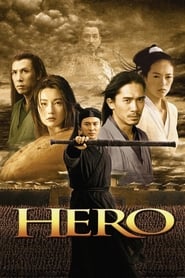
Hero (2002)
Zhang Yimou is Rashomon's most gorgeous heir. The same events retold in contradictory versions, truth deferred — but each telling is flooded in its own single color, so you feel the swap in your body before you reason it out. Watch the moment a grove of golden autumn leaves floods to blood-red: nothing in the plot changes the leaves; a feeling does. Christopher Doyle, famous for restless handheld work, submits here to rigorous, architectural composition — and Emi Wada, who dressed Ran's color-divided armies, brings that same graphic sensibility to the massed formations and saturated silks.
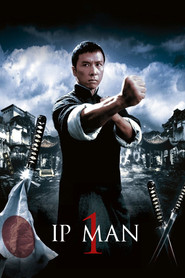
Ip Man (2008)
The fascinating counter-example: a film that restores the old contract the others complicate. For most of an hour, watch a master decline to fight — sparring behind closed doors, eating with his wife in golden lamplight filtered through latticed windows. Track how the visual grammar shifts as occupation arrives, warm shallow interiors giving way to something harsher. When the violence finally comes, it doesn't feel like spectacle; it feels like a circuit closing — a body answering a world that has pressed on it too long. Notice too how Wing Chun's philosophy of simultaneous defense and attack becomes the film's whole moral argument in kinetic form.
Why watch these together? Because they teach each other. Rashomon's untrustworthy testimony becomes Hero's color-coded retellings; Kagemusha's banner system becomes Ran's battlefield palette; Seven Samurai's multi-camera battles echo through decades of combat filmmaking; Miyagawa's lens links Kurosawa's forest to Mizoguchi's misted lake. You'll watch identity forged, worn, and performed — a thief becoming a warlord, a ronin inventing his name from a field. You'll watch the camera shift from chasing action to simply watching it, and feel what that shift does to you. And by the end, when a screen floods red because grief demands it, you'll understand that these filmmakers spent half a century discovering the same thing from different directions: the image doesn't just record the world. It argues with it.