Sightlines · a mini film course
When the Camera Watches and Nobody Acts: A Program of French Cinema, 1958–2012
There is a shared heartbeat running through every film on this list, and it has nothing to do with nationality or decade. In nearly all of them, something goes wrong with the basic bargain of movie storytelling: a character sees a situation, and then — instead of doing the obvious thing — they stall, drift, talk too much, look too long, or find themselves physically unable to move. The trap springs, the elevator stops, the heist sits in the corner like a coat no one puts on. Watching these films together, you start to notice how each director has built a world where looking and acting have come unstuck from each other. The camera registers everything. The characters can do almost nothing. That gap — between seeing clearly and being able to change what you see — is where all the drama, and most of the beauty, lives.
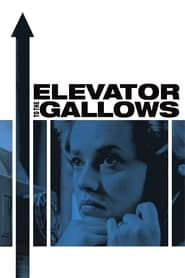
Elevator to the Gallows (1958) — dir. Louis Malle
Watch for the film's two completely different visual personalities. The controlled, shadow-heavy interiors — lit with hard edges and deep blacks — give way at night to something entirely different: a Paris shot on real streets with available light, the camera discovering the city rather than decorating it. Miles Davis improvised the score while watching the footage, and you can hear it responding to what the images do. The great formal trick is that the film's engine stops less than twenty minutes in and never fully restarts — a man who has carefully arranged everything finds himself sealed in a box while the night outside quietly undoes his arrangements. Notice how Malle films Paris after dark: not romantic, not threatening, just real and indifferent.
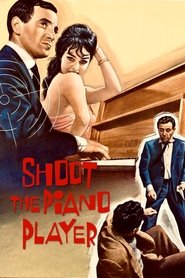
Shoot the Piano Player (1960) — dir. François Truffaut
Pay attention to how Raoul Coutard frames Charles Aznavour — almost always slightly off-center, caught in doorways, reflected in glass, positioned behind the bar's counter as if behind a screen. The camera is fond of Charlie without pushing him toward heroism. Watch also for the film's tonal whiplash: a scene can shift from slapstick to sudden grief and back within a minute, without the music or editing telling you how to feel. The flashback structure, when it arrives, isn't used to excuse Charlie or explain him away — it shows you how a person learns to make themselves small. Truffaut borrowed the shape of an American crime novel and then quietly drained it of its genre certainties; the result is a film that keeps handing its protagonist cues to act on and watching him not take them.
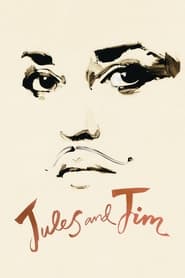
Jules and Jim (1962) — dir. François Truffaut
The great technical signature here is the freeze frame — and the extraordinary thing is that Truffaut deploys it not at a climactic moment but in the middle of happiness, for no reason except that he wants you to look at a face longer than real life would allow. Watch for the variety of Coutard's camera movement, too: a zoom, a track, handheld pursuit through tall grass, an aerial shot — each used once, freshly, rather than as a repeated style. Notice how the voiceover narrates time passing at a pace the images can't keep up with, so that years compress and expand. The film's great subject — whether absolute freedom and lasting love can coexist — is never argued in dialogue so much as acted out in the physical distance and proximity between three people in a frame.

Band of Outsiders (1964) — dir. Jean-Luc Godard
The minute to watch for is the dance: three young people doing the Madison in a fluorescent-lit café, and Godard suddenly cuts the ambient sound — not the music, but the world — and drops his own voice in to tell us what each of them is thinking. It is funny and tender and slightly strange, and it shows you the whole film in miniature: a director who loves his characters enough to step inside the frame and narrate their private experience directly to you. Coutard photographs Paris without making it glamorous — the suburbs are wet and plain — so that when the characters try to live like people in American crime movies, the gap between the fantasy and the actual location becomes quietly comic. The heist, when it arrives, is fumbling and uncinematic. That is precisely the point.
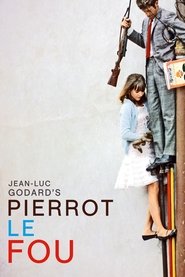
Pierrot le Fou (1965) — dir. Jean-Luc Godard
Watch for the film's use of color as pure feeling rather than description: Coutard will hold a static shot long enough that the composition starts to feel like a painting being consulted — Matisse blues and reds that don't exist in any real apartment. Notice how often Ferdinand addresses the camera directly, making the audience a character in his ongoing argument with experience. Godard is doing something unusual with the genres he's borrowed: the gangster film, the road movie, the love story are all present as costumes the film puts on and takes off without ever committing to their logic. The tension between Ferdinand, who wants to narrate and annotate everything, and Marianne, who wants to live inside the moment, is carried almost entirely by performance — watch how little the two actually agree on what kind of film they're in.

Masculin Féminin (1966) — dir. Jean-Luc Godard
The cinematography is by Willy Kurant, and its key innovation is the extended handheld interview: scenes in which the camera holds a face in close-up for far longer than comfort requires, while a young man asks questions that don't quite get answered. Watch for what those faces do in the silence after a question — the glance away, the cigarette lit to buy time, the smile that means nothing yet. Godard structures the film as a series of discrete episodes, some almost documentary in texture, so that it accumulates the feeling of an inquiry into a generation rather than a conventional story. Jean-Pierre Léaud, who sprinted and schemed through The 400 Blows six years earlier, is here mostly still, mostly listening, mostly mid-sentence — a collector of impressions who cannot convert any of them into action.
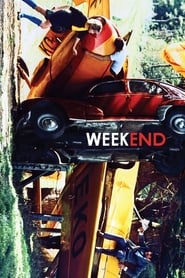
Weekend (1967) — dir. Jean-Luc Godard
The tracking shot along the traffic jam is one of the most discussed single shots in cinema, and it rewards preparation: it runs for roughly seven or eight minutes, the camera gliding at a completely even pace past stalled cars, improvised picnics, a sailboat on a trailer, children playing, and eventually wreckage and bodies — all of it filmed with exactly the same unhurried, lateral attention, scored by unbroken car horns. Nothing in the shot is emphasized over anything else. Watch for how that visual indifference — the camera giving equal weight to a picnic and a corpse — sets the tone for everything that follows. Coutard's color is deliberately harsh and flat, stripping the French countryside of any romantic softness. This is the most extreme film on this list; Godard himself later called it the end of something.
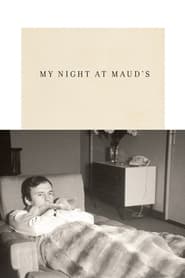
My Night at Maud's (1969) — dir. Éric Rohmer
The entire center of this film takes place in a single apartment over a single night, and the camera barely moves. Nestor Almendros lights the space to feel inhabited rather than staged — the white expanse of Maud's bed is the film's visual center of gravity, carrying a weight entirely out of proportion to anything that happens in it. Watch how Rohmer uses conversation as the film's actual drama: arguments about Pascal, about Catholic faith, about probability and chance are not background texture but the stakes themselves. Notice the gap between what the protagonist says about himself and what his behavior reveals — Rohmer is not making a film about philosophy; he is making a film about a man who uses philosophical fluency to avoid self-knowledge.
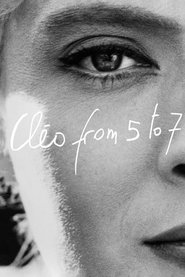
Cléo from 5 to 7 (1962) — dir. Agnès Varda
The film runs in something close to real time — the ninety minutes on screen correspond roughly to ninety minutes in a young woman's life — and watch for what that formal decision costs and gives. Varda's Paris is documentary-specific: actual cafés, actual streets, actual strangers, light that belongs to late afternoon in a real city. The film is divided into chapters named for the people Cléo encounters, which means her identity is partly constructed by who she meets, and watch for how that changes across the film's two halves. Almendros, who would later work with Rohmer and Terrence Malick, shoots with a quality of attention that makes the ordinary feel observed rather than arranged — faces in a café, a taxi window, a park — and that quality of attention is finally what the film is about.
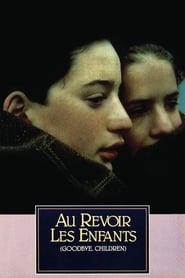
Au Revoir les Enfants (1987) — dir. Louis Malle
Renato Berta's photography is built around cold winter light and a deliberately narrow palette — grays and browns, the blue-white of unheated rooms — so that warmth, when it appears in the film, registers as something earned and fragile. Watch how Malle uses the boarding school's routines — meals, chapel, lessons, games — to establish a precise, confined world with its own hierarchy and codes, because the film needs you to feel at home in that world before history intrudes on it. The lead performance by Gaspard Manesse is built almost entirely out of watchfulness; notice how rarely Julien speaks compared to how much he observes. Malle made this film about something that happened to him as a child, and the formal discipline — nothing aestheticized, nothing underlined — reads as a kind of moral restraint, an adult filmmaker refusing to make childhood suffering picturesque.
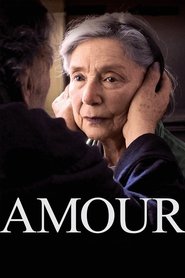
Amour (2012) — dir. Michael Haneke
Darius Khondji's camera is almost entirely static, mounted at a respectful middle distance, and cuts rarely — so that individual shots accumulate a weight of duration, and you find yourself living inside a room rather than passing through it. Watch for how Haneke sources light naturalistically, from windows and lamps, so that the apartment becomes progressively dimmer and more enclosed as the film proceeds. Notice the early scene at a piano recital where, instead of showing us the performer, Haneke turns the camera on the audience — we have to hunt through a hall of strangers to find the two faces we're looking for. That is the film's whole method announced in one setup: you are here to watch people watching, and nothing you see will arm you to intervene. Jean-Louis Trintignant and Emmanuelle Riva give performances built from small physical details — a way of lifting a cup, a shift in posture — that accumulate across the film into something almost unbearably complete.
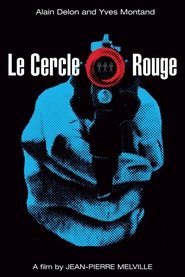
Le Cercle Rouge (1970) — dir. Jean-Pierre Melville
Henri Decaë's photography is the visual opposite of expressionism: shots held past the point where another director would cut, a camera that observes without commenting, compositions built around professional men in rooms. Watch for how much Melville communicates through spatial arrangement and timing rather than dialogue — characters' relationships and intentions are legible from where they stand relative to each other and how long they wait before moving. The heist sequence, when it arrives, runs for roughly twenty-five minutes with no dialogue and no score, only the sound of tools working metal, and it is one of the most purely cinematic passages in French crime film. Notice also the quality of stillness Alain Delon brings: a face that withholds, that watches, that gives almost nothing away — which turns out to be exactly what Melville needs for a film about men who have already accepted where they are headed.
Watching these films as a group, something becomes visible that individual viewing can obscure: this is a cinema in love with the act of looking, and quietly skeptical of the act of doing. From Julien sealed in his elevator to Georges in his Parisian apartment, from Charlie behind his bar to the three dancers in their pocket of silence, these films keep returning to characters who see clearly and cannot change what they see. That is not pessimism, or not only — it is a formal discovery, a way of using the camera that makes the audience into witnesses rather than passengers. The reward for watching these together is that each film teaches you how to watch the next one: a little more patient, a little more attentive to what the frame holds when nothing decisive is happening, a little more willing to sit with a face and let looking be enough.